

Edited by Alexia Angeli
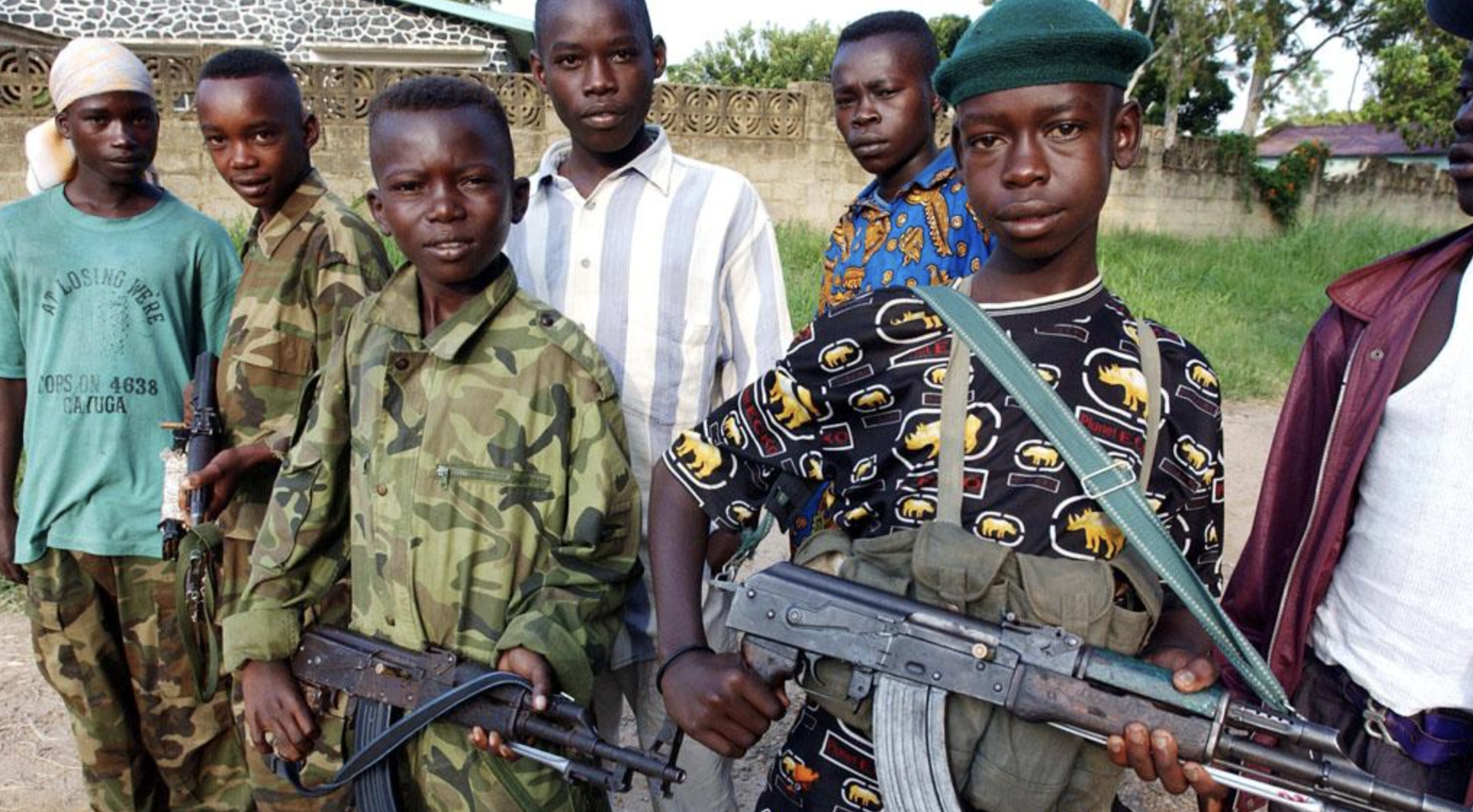
Cover image. https://ingenieriabasica.es/wp-content/uploads/2020/04/Ni%C3%B1os-soldado-con-ak-47.jpg
Introduction
The phenomenon of child soldiers represents one of the most harrowing challenges for the contemporary international legal order, situated at the crossroads of humanitarian protection and criminal accountability. While the international community has made significant strides in prohibiting the recruitment of minors, a profound tension remains between the conceptualization of the child as a passive victim and the reality of their “agency”. This article explores the central question: how can international law reconcile the “victim” status of child soldiers with their individual agency, while simultaneously ensuring justice and effective social reintegration?
To address this topic, the analysis is structured into three pivotal sections.
First, the article examines the international legal framework, tracing the evolution of child soldiers’ protection from the 1997 Cape Town Principles to the more comprehensive 2007 Paris Principles. This transition is crucial as it broadens the definition of “children associated with armed forces or groups” to include non-combat roles, logistical support, and victims of sexual violence. Furthermore, the study evaluates the impact of the Rome Statute, which codifies the recruitment of children under fifteen as a war crime, bringing consistency to the treatment of minors in both international and domestic conflicts.
The second part of this research delves into the “Victim-Perpetrator” paradox. It challenges the reductive Western view that often strips children of their subjectivity, ignoring that many minors exercise a form of tactical agency, joining armed groups as a survival strategy against extreme poverty or as a means to defend their communities. This section highlights the legal and ethical complexities of the Minimum Age of Criminal Responsibility (MACR), arguing that the lack of international consensus creates significant judicial imbalances.
Finally, the article moves toward a restorative justice model, shifting the focus from retribution to rehabilitation. It assesses the role of Disarmament, Demobilization, and Reintegration (DDR) programs and the legal obligations under Article 39 of the Convention on the Rights of the Child, which mandates the right to psychological and social recovery. By recognizing the indispensable role of NGOs in bridging the gaps left by state-run programs, the study concludes that only a holistic, rights-based approach can restore the dignity of former child soldiers and ensure their long-term transition to normality.
International legal framework
1.1 Defining the Child Soldier: from the Cape Town to the Paris Principles
The evolution of international protection for children involved in armed conflicts reflects a gradual legal refinement and growing awareness of the complexity of the phenomenon, moving from the initial formulation of the Cape Town Principles in 1997 to the more organic structure of the Paris Principles in 20071.
Although both documents share the ethical imperative of setting the minimum age for all forms of recruitment and participation in hostilities at 182, thus surpassing the less protective standard of the 1989 UN Convention3, the Paris Principles mark a crucial advance in defining minors no longer only as “child soldiers” but as “children associated with armed forces or groups”. This terminological transition is not purely formal, as it broadens the scope of protection to explicitly include any child used in any capacity, from logistical support roles such as cooks or messengers to victims of sexual exploitation and forced marriage, definitively decoupling victim status from the material possession of a weapon.
The idea that a “child soldier” is not only someone who fights was already present in the 1997 Cape Town Principles. In fact, the evolution towards the 2007 Paris Principles does not amount to a denial of what was said in Cape Town, but is rather an extension and reinforcement of it.
Compared to the Cape Town framework, the Paris Principles introduce a deeper understanding of the causes of recruitment, recognizing that the “voluntary” choice of the child is often the only alternative to hunger, inhumane living conditions, or systemic violence, and the Principles also drastically strengthen legal guarantees. The protections, therefore, do not remain the same but grow significantly: demobilization becomes an unconditional process that must not depend on political negotiations for adults; there is an absolute ban on considering children who flee as deserters; and there is an unprecedented emphasis on psychological and physical rehabilitation and social reintegration, thereby transforming the international approach from emergency management to a strategy of comprehensive protection of children’s human rights.
Also, these principles emphatically highlight the degrading treatment to which girls and young women are subjected, detailing the risk of forced marriage, sexual exploitation, sexual torture, and the possibility of forced pregnancies during and after the period of combat. The prevention and support measures which ratifying states must introduce encompass the establishment of constructive dialogue between the girls and the society into which they are reintegrated, in order to rebuild mutual trust, and the girls’ participation in physical and psychological care programmes4.
In summary, the Paris Principles consolidate the principles of 1997 by increasing and strengthening protections in terms of legal force and operational pragmatism. Combining this intervention with the Rome Statute results in a mature operational and legal framework through which it is possible to analyze each case.
1.2 The Rome Statute and the prohibition of recruitment
The Rome Statute, which constitutes the basis of the International Criminal Court, opposes and prohibits the recruitment and participation of children under the age of fifteen in military actions. The relevant article is Article 8.2, which effectively recognizes as war crimes both the conscription or enlistment of children under the age of fifteen and their use by armed forces or groups, as active or inactive participation in hostilities. This provision raises two critical issues: the nature of inactive participation and the age considered. In fact, while all other international documents set eighteen as the minimum age for recognising responsibility, this Statute seems to accept and permit the involvement of children aged 15 and over in hostilities. When read in conjunction with Article 75, this article does not seem to recognize sexual violence and slavery perpetrated against persons who have been forced or have voluntarily joined armed groups as crimes against humanity. The culpability of such crimes would seem to be recognized only in cases where the victims are girls and boys who are not soldiers.
A positive aspect of this provision is the resolution of certain discrepancies relating to the content of Additional Protocol I and Additional Protocol II6 to the 1949 Geneva Convention. The first protocol refers to involving children in international armed conflicts, while the second refers to non-international armed conflicts. With the Rome Statute, the two cases are incorporated into a single document, giving them the same importance and legal weight. The treatment of child soldiers is therefore made equal in both international conflicts (Art. 8.2.B.XXVI7) and national conflicts (Art. 8.2.E.VII8): a small but fundamental step that brings order to international law.
The “Victim-Perpetrator” paradox
2.1 The complexity of dual status: victimhood vs criminal agency
Humanitarian organizations and mainstream Western morality tend to frame children as individuals incapable of determining their own destiny and of making decisions, someone to be protected from the evils of the world. This idea does not fully represent or correspond to the idea of children in realities far removed from those of the rich Western world.
The starting point is the internationally approved and used definition of “child soldier” in the 2007 Paris Principles, in which a child soldier is:
“any person below 18 years of age who is or who has been recruited or used by an armed force or armed group in any capacity, including but not limited to children, boys, and girls used as fighters, cooks, porters, messengers, spies or for sexual purposes. It does not only refer to a child who is taking or has taken a direct part in hostilities“9
This is an emotional definition that highlights the contrast between childhood and war, associating two worlds that, according to mainstream morality, should never come together. In this view, children are vulnerable, weak, and small, while soldiers are strong, brave, and violent. Child soldiers, and any children involved in activities related to combat, are therefore considered victims of coercion or forced recruitment by adults, groups, or armed forces.
However, many children, despite having been forcibly recruited, exercise a form of “agency” or will to act, therefore perceiving themselves not only as victims, but as social actors capable of making choices, sometimes dictated by survival strategies in contexts of extreme poverty or injustice. Many children join criminal groups because they represent the only opportunity to get some form of education or training, to receive a hot meal, and to make some money. Some do so to avenge something that has already happened, to make the members of their community proud, or to play an active role in defending their homeland. Others associate with criminal groups because it is a natural stage of growth, a transition to maturity according to the values and culture of the community in which they were born and raised. Given the different perspectives and realities of who a child soldier is and does, it is necessary to overcome the reductive dualism between victim and perpetrator to arrive at a vision that recognizes the human complexity of such individuals. This change in perspective is essential, first and foremost, to ensure genuine justice that is not limited to pity, guaranteeing physical and psychological rehabilitation and social reintegration that allow minors to truly reclaim their lives.
At the same time, recognizing the agency of child soldiers means not negating their subjectivity: acknowledging their capacity for choice also implies recognizing their responsibilities. From this perspective, determining guilt and any ensuing punishment should not be punitive for its own sake, but should be combined with a program of rehabilitation and prevention. Only by treating minors as conscious social actors, and not just as passive subjects to be protected, is it possible to restore the dignity they need to build a future beyond conflicts.
2.2 Minimum age of criminal responsibility (MACR) in International Law
A major difficulty encountered by the courts during trials is related to MACR, the minimum age of criminal responsibility, a minimum age below which children are not considered capable of violating the law.
It is not an easy problem to solve; this is partly because, according to the doctrine of universal jurisdiction10, anyone who commits an international crime can be prosecuted in any state. However, there is no fixed MACR for all states, so each state applies its own domestic limit, resulting in a situation where a thirteen-year-old child could be recognised as the perpetrator of an international crime in Congo, where the MACR is 13, but not in Rwanda, which has set the MACR at 14.
For example, there is universal jurisdiction over genocide, but given that the International Criminal Tribunal called for in Article VI11 of the Genocide Convention has never been created, it remains the duty of the states where the crime occurs to prosecute those responsible, even if they are children. The imbalance grows, as states may decide to use national law to fill in or deviate from international law, while at the same time they may be accused of violating it if they fail to convict a child above the MACR who has actually committed an international crime. The result is a situation in which the criminal responsibility and conviction of child soldiers depends solely on national law and therefore on the place of trial.
The Rome Statute, the Special Court for Sierra Leone and the Convention on the Rights of the Child are fundamental legal interventions but do not resolve this issue.
During the preparatory work for the ICC, there were several proposals to set an international MACR between twenty and twenty-one years of age to put an end to this general disagreement, but nothing came of it. The Special Court for Sierra Leone reached the historic decision not to prosecute children between the ages of fifteen and eighteen, despite the provisions of Article 712 of the Statute, while the CRC left it to states to establish an age below which, at their discretion, children are not considered capable of understanding that they are breaking the law.
There are many reasons why obtaining an international MACR is essential. Firstly, a minimum age that is the same in all countries would help to eliminate discrepancies and inequalities in the sentencing and prosecution of child soldiers in different parts of the world. This would go hand in hand with the principle of universal jurisdiction, since an international MACR would make it possible to prosecute serious crimes committed by children over that age limit anywhere in the world. In addition, international recognition of an age beyond which children are considered aware that they are breaking the law could lead to the creation and development of penalties, rehabilitation
programmes or reintegration opportunities appropriate to the type of criminal being dealt with, namely a child. States must therefore find the right balance between the age at which one becomes aware of one’s actions and the persistent malleability of young minds, as well as consider all the factors related to the social, cultural and economic environment in which one grows up.
This is an important and, at times, very complex challenge, from whose solution further benefits would follow, including those related to rehabilitation and social reintegration.
Towards a model of restorative justice and rehabilitation
3.1 Beyond retributive justice: the role of DDR programs
Article 6 of the Optional Protocol to the CRC asserts that:
“States Parties shall take all feasible measures to ensure that persons within their jurisdiction recruited or used in hostilities contrary to the present Protocol are demobilized or otherwise released from service”.
Therefore, it is necessary to mention DDR programs13, which aim to promote the safety and stability of individuals by disarming them, removing them from military structures or the military group to which they belonged, and then reintegrating them socially and economically. The acronym DDR suggests that there are three main phases. The first stage (first D) involves disarmament: information is gathered about the group to which the individual belongs, the location of the individual to be removed from the armed organization and the type of weapons available; then, their armaments and ammunition are collected and destroyed. The second step is demobilization, the purpose of which is to remove and sever the subject’s ties with other members of the armed group and with the group’s control structures. In this phase, individuals involved in the DDR program receive reintegration assistance in the form of cash to meet their immediate needs. The third and final phase is reintegration, where ex-combatants try to rebuild civilian life in their communities of origin. They are involved in paid activities, small public works projects, health check-ups, and sometimes educational programs.
Thus far, children have always been excluded from this opportunity, essentially because they are not considered a danger in the post-conflict phase and, since the recruitment of children is legally prohibited, DDR programs have not considered appropriate measures for them.
Recently, however, with the growing attention to the phenomenon of child soldiers, DDR programs have been designed specifically for children. For example, they will not receive cash during the demobilization phase, but rather care and support packages focused on educational and recreational activities, psychological support, counseling, and skills training. The reintegration phase for children and young people begins in ICCs (Interim Care Centers14, which are transitional facilities run by NGOs and humanitarian associations to prepare the child for their return and the family for the reception of the former soldier, who, after their combat experience, will have new characteristics and needs.
The concept of “child soldiers” covers a wide range of experiences and roles within armed groups, yet academic and policy discussions have historically focused primarily on male combatants, often overlooking children in non-combat roles and, in particular, girl soldiers. Recent studies highlight that girls may constitute a significant proportion of fighters in contemporary conflicts, but they remain largely excluded from DDR programmes15. Their specific needs, shaped by heightened risks of sexual violence, trauma, stigma, and re-recruitment, are frequently neglected within universalist DDR frameworks that fail to account for gendered experiences and reintegration challenges.
At the same time, DDR programmes are criticised for adopting a predominantly victim-centred approach that prioritises rehabilitation and “normalisation” over accountability. The UN and the ICRC stress that detention and prosecution of former child soldiers should be considered only as a last resort, favouring restorative justice mechanisms where responsibility must be addressed. However, many child-focused DDR initiatives presume innocence and victimhood, often ignoring voluntary recruitment and forms of tactical agency. This emphasis may fail to meet the expectations of victims and communities, especially where humanitarian assistance creates perceptions that former child soldiers are “rewarded” while civilian victims remain unrecognised. Existing research has largely relied on studies of individual countries, such as Sudan, Nepal, or Uganda, without developing a broader comparative understanding of the structural challenges that recur across reintegration initiatives for former child soldiers. This fragmentation has contributed to persistent gaps in DDR design and implementation, particularly regarding key unresolved debates on the definition of child soldiers, voluntary recruitment, accountability and prosecution, and the distinct experiences of girl combatants. Collectively, these issues demonstrate that the lack of integrated scholarship and policy coordination continues to undermine the long-term success of DDR programmes and the sustainable reintegration of former child soldiers into post-conflict societies, highlighting the need for alternative options such as the Truth and Reconciliation Commission.
3.2 The right to recovery: obligations under the Convention on the Rights of the Child
The process of recovery and reintegration for child victims of armed conflict is a multifaceted legal and humanitarian obligation rooted in the necessity of restoring a child’s sense of self and social belonging. Under Article 3916 of the Convention on the Rights of the Child, states are legally bound to take all the appropriate measures to ensure that such recovery takes place in an environment that actively fosters the health, self-respect, and dignity of the child. Achieving this goal requires a focus on both psychological healing and social transition, where physical and psychological recovery addresses the trauma of conflict while social reintegration facilitates the child’s return to civilian life. This is particularly vital for former child soldiers, who are viewed as victims because they lack the emotional, mental, and intellectual maturity to consent to hostilities and are often “more wounded by the world than vice versa”.
Recovery is achieved through a comprehensive set of measures that begin with providing for the child’s basic survival needs, such as medical care and food assistance, but also psychological and economic help.
From a psychological perspective, recovery involves assessing the children’s specific experiences and providing a safe, routine-based environment where they can learn to co-live with their past trauma. A primary mechanism for reaching this stability is family tracing and reunification, as mandated by Articles 9, 10, and 22 of the CRC and supported by the Geneva Conventions. Reuniting a child with their family or a familiar community provides the primary relationships and social networks necessary for emotional, cognitive and social development.
Furthermore, education serves as a critical tool for both recovery and reintegration, as it offers a sense of normality and future opportunity for children, including refugees and displaced minors. Under Article 28 of the CRC, access to primary education must be ensured to progressively achieve the child’s development and reintegration into society.
Physical safety is also a prerequisite for recovery; therefore, demining activities are essential to protect children, and surely others, from the devastating medical and psychological effects of landmines that persist long after a war is over.
co-operating with the United Nations to protect and assist such a child and to trace the parents or other members of the family of any refugee child in order to obtain information necessary for reunification with his or her family. In cases where no parents or other members of the family can be found, the child shall be accorded the same protection as any other child permanently or temporarily deprived of his or her family environment for any reason , as set forth in the present Convention”.
Ultimately, the success of these recovery measures depends on Article 4 of the CRC17, which requires states to prioritize budgetary allocations and international cooperation to the maximum extent of their available resources to support the cause.
In conclusion, the realization of the right to recovery and reintegration as enshrined in Article 39 of the CRC necessitates a holistic approach that transcends mere legal compliance. Because child victims, and particularly former child soldiers, suffer from severe physical and psychological trauma that disrupts their fundamental development, the state’s duty extends beyond immediate relief to the creation of a sustainable, “as normal as possible” environment. These state-run programs are often fraught with institutional red tape, rigid and slow, which is why it is beneficial to involve other types of organizations and NGOs.
3.3 The role of NGOs and non-state actors in the recovery phase
While states bear the primary responsibility for the protection of children, the recovery and reintegration of child victims of armed conflict is a shared responsibility involving international organizations and non-governmental organizations (NGOs). In many jurisdictions, NGOs and civil society partners serve as vital collaborators in the field, working alongside government bodies to ensure that the mandates of Article 39 are translated into tangible actions on the ground.
These organizations provide a broad spectrum of specialized services, including medical care, legal aid, vocational training and psychological counselling, which are often more accessible and agile than state-run programs in post-conflict zones. Furthermore, international organizations like UNICEF, the ICRC, and specialized NGOs play a cornerstone role in family tracing and reunification as outlined in Article 22 of the CRC. They facilitate the search for displaced family members, manage vital documentation to verify relationships, and coordinate the safe return of separated or unaccompanied refugee children.
Beyond direct service provision, NGOs act as critical monitors and advocates in the implementation of the Convention. National child rights organizations often prepare “alternative reports” for the UN Committee on the Rights of the Child, providing an independent assessment of state compliance and highlighting gaps in recovery services. These organizations also engage in community-based awareness campaigns to educate the public on children’s status as rights-holders, helping to combat the stigmatization that former child soldiers or victims of sexual violence might face. By bridging the gap between international legal standards and the actual needs of children, these actors foster the safe, rights-based environment required for a child’s long-term transition to normality and dignity.
In conclusion, the active participation of non-governmental organizations, civil society actors and international institutions is indispensable to the effective realization of the obligations enshrined in the Convention on the Rights of the Child. Through the provision of specialized assistance, the facilitation of family tracing and reunification, the monitoring of state compliance, and physical presence in the territory, these actors significantly contribute to translating international legal norms into meaningful protection and recovery mechanisms. Ultimately, only through sustained, coordinated, and multi-level cooperation between state and non-state stakeholders can a comprehensive rights-based framework be established, ensuring that child victims of armed conflict can achieve long-term rehabilitation, social reintegration, and the restoration of their dignity and well-being.
Conclusion
The analysis conducted in this research highlights that the issue of child soldiers is not merely a legal challenge, but a profound ethical and judicial dilemma that forces international law to explore the boundaries of responsibility, agency, and protection. The central inquiry of this study sought to determine how the international legal system could reconcile the dual status of the child as both a victim of systemic violence and a participant with individual agency. As demonstrated throughout the sections, while the legal framework has evolved significantly from the Cape Town to the Paris Principles, a complex gap persists between the theoretical protection of “children associated with armed forces” and the practical reality of their experiences.
The “Victim-Perpetrator” paradox remains the most challenging element of this discourse. This article has argued that viewing child soldiers through a purely reductive lens of “passive victimhood” is often insufficient to capture the reality of conflict. Many minors exercise what is defined as “tactical agency,” making choices for survival in environments where no safe alternatives exist. However, recognizing this agency must not lead to a return to punitive justice. The lack of a common International Minimum Age of Criminal Responsibility (MACR) continues to create significant imbalances, often leaving minors vulnerable to inconsistent domestic standards that prioritize punishment over rehabilitation.
Ultimately, the transition toward a restorative justice model represents the only viable path for sustainable individual recovery. As explored in the final section, the success of reintegration depends on moving beyond military logic to embrace a rights-based approach. The obligations enshrined in Article 39 of the Convention on the Rights of the Child are the foundation upon which the child’s future must be rebuilt, ensuring their right to psychological and social recovery.
Furthermore, the role of non-governmental organizations and civil society has proven to be indispensable. While international statutes and the Rome Statute provide the necessary legal norms, it is the work of these non-state actors on the ground, facilitating family reunification, providing specialized medical care, and monitoring state compliance, that translates abstract laws into meaningful protection.
In conclusion, international law must continue to evolve toward a framework where the protection of the children’s future is never sacrificed for the sake of retributive justice, ensuring that these minors are finally seen as rights-holders entitled to a transition back to normality and dignity.
- Other key developments include Optional Protocol to the Convention on the Rights and Welfare of the Child (May 25, 2000) African Charter on the Rights and Welfare of the Child (November 29, 1999). ↩︎
- Cape Town Principles: “A minimum age of 18 years must be established for any person participating in hostilities and for recruitment in any form into any armed force or armed group”. Whereas the definition of “Child” in the Paris Principles: “Child” refers to any person under the age of 18 years in accordance with the Convention on the Rights of the Child. ↩︎
- 1989 UN Convention, art. 38.2: “States Parties shall take all feasible measures to ensure that persons who have not attained the age of fifteen years do not take a direct part in hostilities”. Art 38.3: “States Parties shall refrain from recruiting any person who has not attained the age of fifteen years into their armed forces. In recruiting among those persons who have attained the age of fifteen years, but who have not attained the age of eighteen years, States Parties shall endeavour to give priority to those who are oldest”. ↩︎
- Articles 7.59-7.67 Paris Protocol (February 2007). ↩︎
- Art. 7 Rome Statute- “Crimes against humanity”: “1. For the purpose of this Statute, “crime against humanity” means any of the following acts when committed as part of a widespread or systematic attack directed against any civilian population, with knowledge of the attack: (…) (g) Rape, sexual slavery, enforced prostitution, forced pregnancy, enforced sterilization, or any other form of sexual violence of comparable gravity; (…)(k) Other inhumane acts of a similar character intentionally causing great suffering, or serious injury to body or to mental or physical health”. ↩︎
- The Additional Protocols are international treaties that supplement and update the four Geneva Conventions of 1949. While the original 1949 Conventions focused primarily on the protection of the wounded, prisoners of war, and civilians under occupation, the Additional Protocols (adopted in 1977) were created to respond to the new realities of modern warfare (such as wars of national liberation and internal conflicts).
↩︎ - Art.8(b) “Other serious violations of the laws and customs applicable in international armed conflict, within the established framework of international law, namely, any of the following acts:(…)(XXVI) Conscripting or enlisting children under the age of fifteen years into the national armed forces or using them to participate actively in hostilities”. ↩︎
- Art.8(e) “Other serious violations of the laws and customs applicable in armed conflicts not of an international character, within the established framework of international law, namely, any of the following acts:(…)(VII) Conscripting or enlisting children under the age of fifteen years into armed forces or groups or using them to participate actively in hostilities”. ↩︎
- The Paris Principles (2007)2.1 Definitions ↩︎
- Definition: The principle of universal jurisdiction authorizes or requires a State to initiate criminal proceedings regardless of where the crime was committed and the nationality of the perpetrator or victim (Interparliamentary meeting of the Legal Affairs Committee (JURI) and the Human Rights Committee (DROI) of the European Parliament on universal jurisdiction, Brussels, November 28, 2022). ↩︎
- Art.6 Convention on the Prevention and Punishment of the Crime of Genocide : “Persons charged with genocide or any of the other acts enumerated in article III shall be tried by a competent tribunal of the State in the territory of which the act was committed, or by such international penal tribunal as may have jurisdiction with respect to those Contracting Parties which shall have accepted its jurisdiction ↩︎
- Art. 7 SCSL – Jurisdiction over persons of 15 years of age: “1. The Special Court shall have no jurisdiction over any person who was under the age of 15 at the time of the alleged commission of the crime. Should any person who was at the time of the alleged commission of the crime between 15 and 18 years of age come before the Court, he or she shall be treated with dignity and a sense of worth, taking into account his or her young age and the desirability of promoting his or her rehabilitation, reintegration into and assumption of a constructive role in society, and in accordance with international human rights standards, in particular the rights of the child”. ↩︎
- United Nations Integrated Disarmament, Demobilization and Reintegration Standards (IDDRS), Inter-Agency Working Group on DDR, ONU, 2006 ↩︎
- United Nations, Integrated DDR Standards (IDDRS), Module 5.30: Children and DDR ↩︎
- Resolution 1325 (2000), UN Security Council: (8) “(…) Calls on all actors involved, when negotiating and implementing peace agreements, to adopt a gender perspective, including, inter alia: a. The special needs of women and girls during repatriation and resettlement and for rehabilitation, reintegration and post-conflict reconstruction (…)” ↩︎
- Art. 39 CRC: “States Parties shall take all appropriate measures to promote physical and psychological recovery and social reintegration of a child victim of: any form of neglect, exploitation, or abuse; torture or any other form of cruel, inhuman or degrading treatment or punishment; or armed conflicts. Such recovery and reintegration shall take place in an environment which fosters the health, self-respect and dignity of the child”. ↩︎
- Art.4 CRC:” States Parties shall undertake all appropriate legislative, administrative, and other measures for the implementation of the rights recognized in the present Convention. With regard to economic, social and cultural rights, States Parties shall undertake such measures to the maximum extent of their available resources and, where needed, within the framework of international co-operation”. ↩︎