

Edited by Alexia Angeli
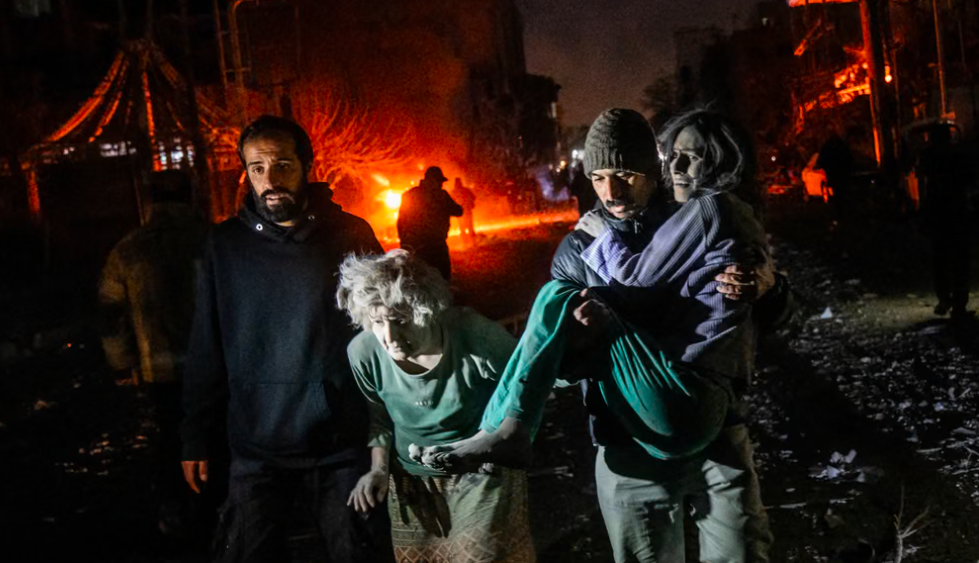
Cover image. The Guardian, Conflict deepens across Middle East (in pictures)
The background
The attacks took place unexpectedly during the negotiations over Iran’s nuclear program with the United States, which began on 12th April 2025. A month and a half later, President Trump expressed optimism about reaching an agreement; However, at the end of May, the International Atomic Energy Agency IAEA disclosed that Iran had accumulated a record amount of military-grade enriched uranium. In June, US embassies in Arab states began evacuating personnel in response to threats of an Iranian atomic bomb against American bases and the President was reportedly provided with a range of options by CENTCOM.

Image 1. The New York Times, Mapping the Israel-Iran conflict, 24 June 2025
On 13 June, Israel and the United States launched a major offensive against Iran, targeting high-ranking military leaders and nuclear scientists. This event is referred to as the Twelve-day war. As a consequence, Iran suspended the negotiations. Ali Larijani, Secretary of the SNSC and a key figure in the bilateral talks, was assassinated on 17th March 2026.
The Iran war
The crisis started in January, when Iranian security forces massacred thousands of civilians during the largest protests since the 1979 Iranian Revolution – the event that established the Islamic Republic of Iran. In response, US President Trump threatened military action and started the largest US military buildup in the region since the 2003 invasion of Iraq.
On 28th February 2026, the United States and Israel launched the first attacks on Iran targeting both military and civilian infrastructure. Attacks resulted in the assassination of the Supreme Leader Ali Khamenei and other officials.
Image 2. The Guardian, ‘Her head was broken’: parents at Iranian school bombed by US describe their worst day
Among the initial atrocities, it is important to acknowledge the Minab massacre, an unlawful US strike that directly targeted Shajareh Tayyebeh elementary school on the morning of 28th February, resulting in 175 fatalities, including over 100 children.

On 10 March, a spokesperson from the White House announced that the US Department of Defence would release the findings of an investigation. In the meantime, preliminary results indicated that the United States likely to be responsible for war crimes.
Iran, for its part, responded with strikes against Israel, US bases in the region and other Arab countries, thereby instigating the ongoing Middle Eastern conflict and precipitating the most significant disruption to global oil supplies since the 1970s, which was caused by the closure of the Strait of Hormuz. Gas and oil prices surged, the aviation sector was disrupted and the financial markets became increasingly unstable. At present, the United Nations’ primary course of action aimed at halting the war and its deleterious consequences has been the adoption of a resolution that denounces Iran’s retaliatory measures.
The Lebanon war
The ongoing dispute between Hezbollah and Israel is part of a conflict officially began in late 2023; however, the state of war between the two nations has technically persisted since 1948, when Lebanon, in alignment with other Arab countries, expressed opposition to the establishment of Israel.
Hezbollah (meaning “party of God”) is a Lebanese Islamist political and militant group, considered one of the world’s most heavily armed non-state militias. It is aligned with the Iranian Axis of Resistance, a group of Arab allied organizations against the US, Israel and Saudi Arabia’s power in the region. It emerged during the 1982 Israeli invasion of the country, resulted in more than 17.000 deaths and 30.000 injuries. It was not until the year 2000 that they formally withdrew.
Another significant clash is known as the 2006 Lebanon war, during which Hezbollah is considered the winner. It launched strikes against Israel, held off advances and ambushed troops in a retaliatory invasion in the south.
On 8th October 2023, Hezbollah launched military attacks against Israel, expressing solidarity with Palestine in response to the attack of the previous day. The conflict escalated into prolonged, reciprocal violence and led to extensive displacement within both Israel and Lebanon.
In September 2024, Israel intensified its military operations and, on October 1st, it invaded the southern region of the country, leading to significant destruction of the military infrastructure of the group and the assassination of Hassan Nasrallah, Hezbollah’s secretary general.
On 27th November, a 60-day ceasefire agreement was reached, though Israel retained the right to strike to immediate threats. The deal was later extended to 18th February 2025, when the Israel Defense Forces finally began withdrawing from most of the occupied territory. Despite the agreement, Israeli airstrikes continued nearly every day, resulting in a death toll of 500 people. According to the United Nations Interim Force in Lebanon (UNIFIL), more than 10,000 violations were documented through late 2025. The Lebanese government reported over 5,350 violations within the first year, including the killing of at least 500 people, 127 of whom were civilians.
On 2nd March 2026, the conflict resumed when Hezbollah launched missiles at Israel in response to the assassination of Ali Khamenei and the general violence in Iran – one of the armed group’s closest backers – since 28th February.

As in Gaza, the targets have included infrastructure, power stations, water systems, telecommunications, and factories. Additionally, forces have sprayed cancer-linked herbicide. A massive humanitarian crisis has emerged, compounded by the fact that evacuation orders left 1.3 million residents with nowhere safe to go.

Image 4. Human Rights watch, Lebanon: Israeli strikes kill hundreds, damage vital bridge
The deadliest day occurred on 8th April, shortly after the announcement of a ceasefire, when over 100 strikes (simultaneously in multiple areas of the country) within 10 minutes killed at least 357 people and damaged the last main bridge connecting southern Lebanon with the rest of the country.
The Lebanese government has denounced the actions of Hezbollah and banned the Organization, while also diplomatically demanding the return of its occupied land. Israeli Prime Minister Benjamin Netanyahu expressed support for Lebanon in these efforts, but warned that he would continue attacks if Hezbollah remains armed along the border.
Peace
Peace talks in Pakistan between Iran, the US and Israel resulted in a two-week ceasefire on 8th April, following protracted deliberations concerning nuclear armaments, as the chief of the US delegation, Vice President J. D. Vance, stated:
“The simple fact is that we need to see an affirmative commitment that they will not seek a nuclear weapon, and they will not seek the tools that would enable them to quickly achieve a nuclear weapon”.
At the outset, Pakistan indicated that Lebanon was to be included in the agreement, but the Americans and the Israelis never incorporated it into the ceasefire. The Iranian Parliament Speaker Mohammad Qabilaf stressed that Lebanon and the Axis of Resistance are “an inseparable part of the ceasefire”. A 10-day truce between Lebanon and Israel was finally achieved only on April 16. The Strait of Hormuz remains partially closed and is currently under US blockade.
The right of existence and work of journalists
A crucial dimension of the Middle Eastern conflict is the breach of press freedom; the systematic assassination and persecution of journalists and media workers is not merely a loss of life, it is also an attack on the fundamental role these professionals play in upholding global accountability.
It is estimated that at least 262 journalists and media workers have been killed across Gaza, Yemen, Lebanon, Israel and Iran. The charge of being Hamas members was levelled against the deceased by Israel. Consequently, Israel has become the country responsible for the highest number of journalist killings since 1992, when the Committee to Protect Journalists (CPJ) began collecting data.

Image 5. Washington Post, The journalist killed in Gaza – and what they tried to show the world
- 207 Palestinians journalists or media workers killed in Gaza
- 2 Palestinian killed in Gaza during the Iran war
- 2 Palestinians killed in Israeli detention centers
- 31 Yemenis in Yemen
- 6 Lebanese in Lebanon during the Iran war3
- Iranians in Iran during the 12-day war
- 1 Iranian killed in US-Israeli strikes
- 2 Israelis killed in Israel by Hamas
- 1 Palestinian journalist killed by an armed group in Gaza
- 174 journalists or media workers injured
- 2 journalists or media workers missing
- 107 journalists or media workers arrested
- Attacks, arrests, threats, censorship and killings of family members are not counted.
Among who was targeted illuminating the darkness of the war, we remember:
Ali Shoaib
Fatima Ftouni
Mohamad Ftouni
Mohammed al-Bardaweel
Mohamed al-Maqri
Murad Halboub al-Faquih
Mohamed Qeshta
Mohmoud Wadi
Anas Ghnaim
Abed Shaat
Ahmad Qalaja
Ahmed Mansour
Anas al-Sharif
Ayman Al-Gedi
Fadi Hassouna
Faisal Abu Al Qumsan
Ghassan Najjar
Hamza Al-Dahdouh
Abbas al-Dailami
Youssef Shams al-Din al-Bahri
Mohammed al-Omeisi
Abdullah al-Harazi
Jamal al-Adhi
Bashir Hussein Ahsan Dablan
Abdulqawi Mohammed Saleh al-Asfour
Abdo Taher Musleh al-Saadi
Luft Ahmed Nasser Hadiyan
Qais Abdo Ahmed al-Naqeeb
Mohammed Ali Hamoud al-Dawi
Faris Abdo Ali al-Rumaisa
Abdulrahman Mohammed Jaman
Amal Mohammed Ghaleb al-Manakhi
Abdullah Mahdi Abdullah al-Bahri
Sami Mohammed Hussein al-Zaidi
Mari Abu Dagga
Hussam Al-Masri
Mohammed Salama
Ahmed Abu Aziz
Moaz Abu Taha
Mohammed Washah
Ubrahim Sheikh Ali
Mosaoumeh Azimi
Mohammed RedaIbrahim
Murad Halboub al-Faquih
Ali Naji al-Shara’i
Ali MOhammed Ahmed al-Faquih
Arif Ali Abdo al-Samhi
Mohammed Hamoud Ahmed al-Matari
Abdul Wali Abdo Hussein al-Najjar
Abdul Aziz Saleh Shas
Mohammed Ahmed Mohammed al-Zakri
Zuhair Ahmed Mohammed al-Zakri
Essam Mohammed al-Zakri
Essam Ahmed Murshid al-Hashidi
Salim Abdullah Abdo Ahmed al-Watiri
Mohammed Abdo Yahya al-Sanfi
Mohammed Al-Azzi Ghaleb al-Harazi
Ali Mohammed al-Aqel
Hussan Hamood
Mohammed Sherri
Suzan Khalil
Rabih Al Maamari
Mohamad Shehab
Hilmi al-Faqaawi
Hossam Shabat
Ibrahim Zaher
Ismail Al Ghoul
Ismail Baddah
Issam Abdallah
Mohamoud Islim Al-Basos
Moamen Aliwa
Mohammad al-Khaldi
Mohammed Al-Ladaa
Mohammed Noufal
Mohammed Qreiqeh
Mustafa Thuraya
Nima Rajabpour
Rami Al Refee
Suleiman Hajjaj
Wissam Kassem
Abdulaziz Al-Sheikh
Ghada Dayekh
Farah Omar
Amal Khalil
Ayat Khadoura
Amro Salah Abu Hayah
Abu Huwaidi
Yacoub al-Barsh