



Edited by Alexia Angeli
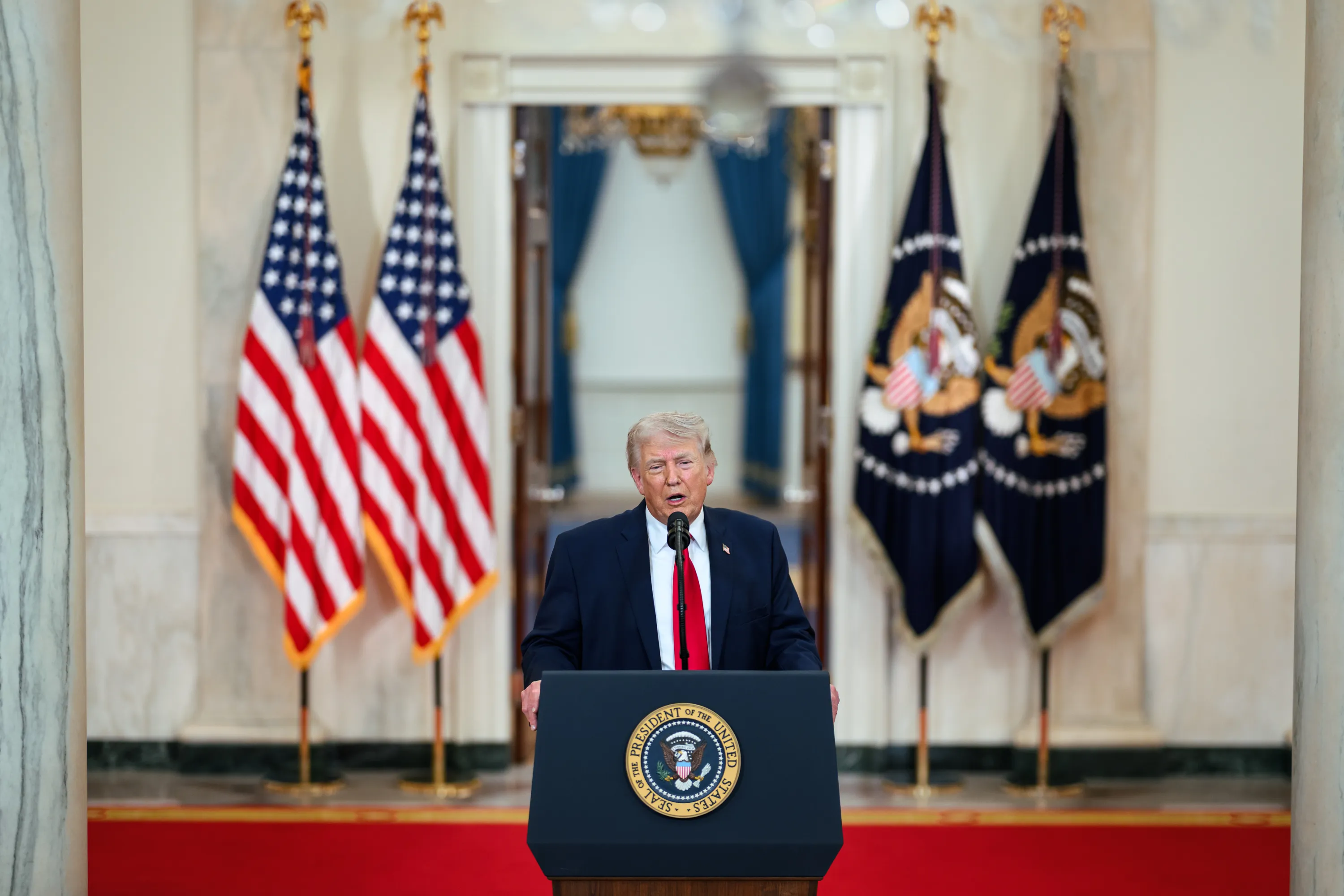
Cover image. The White House. (2026, April 1). President Donald Trump delivers an address to the Nation.
On 1st April, 2026, President Donald Trump delivered a televised address from the White House that functioned as both a military progress report and a high-stakes psychological ultimatum. Following the initiation of Operation Epic Fury on 28th February, this address sought to portray a complex and expanding conflict as a succession of absolute victories spearheaded by a lone, authoritative figure. Whilst the customary objective of institutional war speeches is to promote solemnity and diplomatic nuance, Trump’s address transformed the event into a performance of personal magnification, whereby the future of an entire nation was reduced to a mere three-week countdown. The speech conveys an image of the 47th President as a moral judge delivering a definitive verdict on the Iranian regime.
The core of the address centred on a narrative of total military dominance, designed to reassure a domestic audience of the war’s imminent conclusion. Trump framed the current status of the conflict as one of “swift, decisive, overwhelming victories on the battlefield”, asserting that the U.S. had achieved results “like few people have ever seen before”. By declaring that “tonight, Iran’s navy is gone” and “their air force is in ruins”, the President distilled the intricate technicalities of modern warfare into a straightforward representation of a mission accomplished. This rhetorical strategy serves a dual purpose. Firstly, it validates the initial decision to engage in what critics have termed a “war of choice”, and, secondly, it establishes a baseline of American primacy that justifies any subsequent escalation. The underlying message is that the United States are succeeding because their leader is willing to be more assertive than his predecessors.
The most salient and significant part of the speech, one with profound future implications for the region, was the pivot from conventional military targets to civilian and economic infrastructure. Trump issued an ultimatum, thereby affording the Iranian leadership a narrow window of opportunity to reach a deal or face unprecedented devastation. His threat to “bring them back to the stone ages, where they belong” indicates a transition from targeted military objectives to a broader strategy of total societal collapse. By threatening to “hit each and every one of their electric generating plants…probably simultaneously”, Trump advanced from the destruction of the regime’s “command and control” to the systematic dismantling of the Iranian state’s capacity to function as a modern nation. Should this course of action be pursued, the consequences would not only be a military victory, but also a generational catastrophe for the Iranian people, with the potential to engender a pre-industrial existence for millions.
The justification provided by Trump for this escalation is deeply rooted in a discourse of self-legitimisation and historical revisionism. In a manner analogous to his characterisation of the 2026 State of the Union as a “national rescue”, he has made a conscious effort to differentiate his current actions from the perceived failures of previous administrations. He claimed, “essentially, I did what no other president was willing to do. They made mistakes, and I am correcting them”. By specifically citing the termination of the Obama-era nuclear deal as a move that saved the Middle East and Israel, Trump positioned himself as a “saviour” figure for global safety. This narrative simplifies the vast and complex field of geopolitics into a binary moral confrontation, where he is the only actor with the strength to end “nuclear blackmail”. Within this framework, his personal authority and the nation’s security become indistinguishable; the focus of the speech is less about a strategic plan for the region and more about the affirmation of Trump’s own judgment.
The President also used antagonism as a central tool to manage the domestic fallout of the war, specifically the surge in gasoline prices. Prices have increased by 30% since the war began, reaching a cost of over $4 per gallon. In response, President Trump employed a rhetorical strategy to deflect criticism and ensure that his administration remained unaccountable. He claimed the price hikes were “entirely the result of the Iranian regime launching deranged terror attacks” against oil tankers and neighbouring countries. By labelling the regime’s actions as “deranged”, he removed the conflict from the realm of policy debate and placed it into a moral category. This approach mirrors his domestic strategy of portraying political opponents as “enemies of the common good” to create a shared vision through the establishment of a common enemy. Despite the observation of market analysts that the war itself and the closure of the Strait of Hormuz are the primary drivers of oil prices in excess of $100, Trump’s language sought to redirect public anger away from the White House and towards a foreign adversary.
Furthermore, the President’s employment of inflated statistics functioned as a staging device to provide moral “living proof” for his aggression. He cited a figure of 45,000 Iranians killed in a crackdown prior to U.S. intervention, a number significantly higher than the 30,000 estimated by independent reports such as The Guardian. For Trump, the absolute accuracy of the data is secondary to its rhetorical function. Here, the numbers serve as a moral verdict that justifies hitting the regime “extremely hard”. By presenting the regime as so uniquely “evil”, he sets a trap for his domestic critics. Should they be found to question the severity of the proposed “Stone Age” strikes, they risk being perceived as sympathising with a regime that has been characterised by mass slaughter.
The future implications of the Iran situation, as outlined in this address, continue to be contingent upon what critics have described as a “moving target” of justifications. While Trump mentioned that “discussions are ongoing” and a “new regime president” has supposedly requested a ceasefire, the the absence of a coherent strategy to secure nuclear material or reopen the Strait of Hormuz engenders a state of elevated uncertainty. The apparent contradiction between the assertion that the war is “nearly over” and the simultaneous mobilisation of a Marine force for potential deployment on the ground suggests that the “three-week” timeline is more of a psychological pressure tactic than a fixed military exit strategy.
The economic consequences of this strategy are equally significant. Trump dismissed concerns about the closure of the Strait of Hormuz by asserting American energy independence, stating, “we don’t need their oil. We don’t need anything they have”. This “America First” stance reinforces his doctrine of national self-sufficiency but ignores the reality that the war has triggered the largest oil supply disruption in history, with Asia and Europe facing imminent fuel shortages. This reflects a presidency that prioritizes the display of American primacy over international economic stability.
Conclusions
The address delivered on 1st April was not merely a military update, but rather a confirmation of power by President Trump. His rhetoric turned a solemn military announcement into a stage on which legitimacy was enacted before a global audience. Instead of appearing as a leader constrained by traditional diplomatic norms, Trump presented the presidency as a vehicle for his personal will to reshape the world through overwhelming force. By using simplified, forceful language, moving from the “Golden Age” of America to the “Stone Age” for his enemies, he signalled a total disregard for the status quo. As the three-week deadline for his ultimatum approaches, the address leaves unmistakably clear that the future of Iran and the global economy is being shaped not by a long-term strategic vision, but by the personal authority and shifting objectives of the man who has the power to shape the narrative. The speech confirms that for Trump, every institutional moment is an opportunity to turn a national crisis into a political spectacle of leadership and predominance.