

Edited by Sokhna Fall
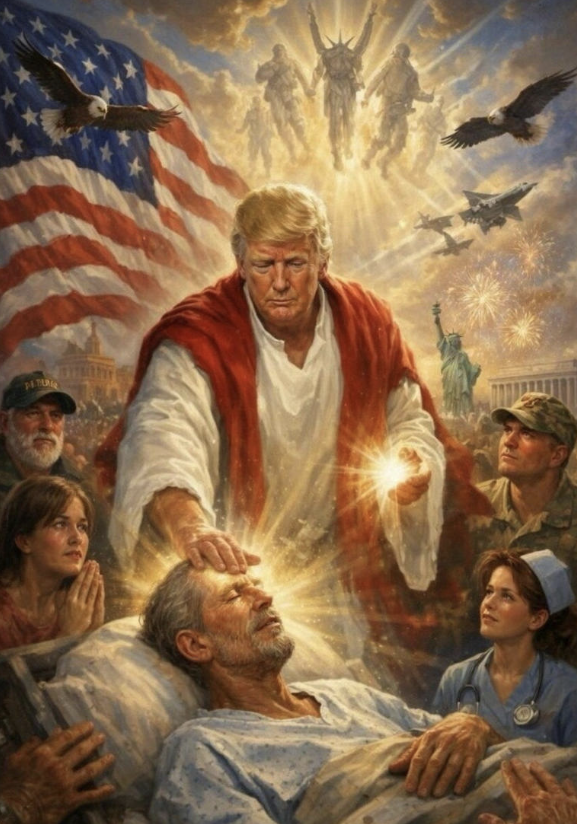
Cover image AI generated image posted on President Trump’s official channels.
Relations between the United States and the Vatican have never been merely diplomatic, but rather a mixture of politics, religion, morality and public opinion: hence, the recent complications between the President of the United States and Pope Leo XIV cannot be reduced to a minor disagreement between two heads of state, one of which also happens to be the leader of the Catholic Church. Instead, this quarrel reveals a clash between two forms of authority which stand at the polar opposite: on one hand, Donald Trump’s rhetoric has frequently relied on personalization, spectacularization and usage of religious imagery (as clearly shown on the multiple AI-generated images elevating DJT to godhood), whereas Pope Prevost’s language has been built upon preachings of peace, respect for war victims and the moral limits of political power.
The sparkle which led to the dispute was Pope Leo’s position on war, especially targeting the U.S.-Israeli conflict with Iran: before Secretary of State Marco Rubio’s visit to the Vatican, the Pope had stood firmly with the victims of the conflict, arguing that the Church’s role consisted in denouncing evil and announcing peace. The language used by the head of the Church is crucial, as it doesn’t frame its position as that of a neutral observer, but neither turns into a partisan actor: power, violence and international responsibility are spoken of on behalf of the weak and vulnerable rather than from the viewpoint of the so-called victorious. This position was also held throughout the meeting between Pope Leo and Marco Rubio, the U.S. Secretary of State, which renewed the commitment to good bilateral relations between the Holy See and the United States, focused on countries scorched by wars, conflicts and humanitarian crises, mostly in the Middle East and in Africa, but by always insisting on the Vatican’s decision to “work tirelessly” for peace. It is not new for Donald Trump to throw tantrums when other heads of state act differently from his own expectancies, and Pope Prevost’s cordial talks with the US Secretary of State are nothing but a classy diplomatic response to a global actor who insists on always having things go his own way: this is where the differences between the multiple speeches of the two sides differ, with the Vatican’s vocabulary consisting of morality and peace messages rather than further escalating the conflict.
By contrast, Donald Trump’s messages are often grounded in conflictual personalization and ad hominem fallacies: according to the President of the United States, the Pope“is not doing a very good job”[1], depicted as “a very liberal person … who should stop catering to the Radical Left”[2]. Anyone following Donald Trump’s speeches over time can immediately notice these words as typically Trumpian: the opponent is not only wrong, but aligned with enemies that seem to despite the well-being of society. The debate therefore shifts its focus from the war in Iran to the personal credibility of the speaker, Pope Leo in this case. What catches the eye this time isn’t the usual strategy used by Trump, which has become a steady trait of his international politics, but rather his usage of sacred imagery to represent himself: images depicting the POTUS as a Jesus-like figure where shared on multiple instances on social medias, despite being later deleted and framed as “misunderstood”, claiming the images as a representation of him as a doctor saving a bedridden patient.

Even if a reader decides to accept such words as true (which, by having a look at Trump’s personality and ego tendencies, happens to be complicated), the symbolic point stands: the authority of the President of the United States plays with the visual grammar of salvation and sacred authority, overstepping its boundaries and claiming the role which belongs to the Church. Trump’s words of regret barely stand as credible when also considering other reposts of the President, such as the one reported by Reuters showing Jesus embracing him and playing around the phrase “God might be playing his Trump Card”[3]. Once again, sacrality and the concept of “chosen one” isn’t outside politics, but it becomes part of political campaigns.

Image 2. Weissert, W., Boak, J., & Winfield, N. (2026, April 13). Trump says he won’t apologize to Pope Leo | AP News. AP News. https://apnews.com/article/trump-pope-leo-xiv-02f6b4554ea4b83af02af15987ae1f2d
The two heads of state couldn’t be more different. Pope Leo’s rhetoric refuses spectacle, whereas Donald Trump plays with it: “If someone wants to criticize me for announcing the gospel, let him do it with the truth”[4]. These words coming from the head of the Church define a messenger defending the moral source of his speech rather than his figure as a politician. Here the type of speeches differ: the Pope’s speeches are built on depersonalization, Trump’s on personalization. While Trump says that the Pope is wrong, liberal, weak, politically captured, the latter answers that the Gospel demands peace, the Church stands with victims, and that war must be judged morally.
Catholic social rhetoric can be seen on multiple instances throughout the speeches of the Pope: the conflict between Israel and Iran isn’t merely about foreign policy, but also regarding who has the right to appeal to religion to defend his own claims. Religious imagery shouldn’t be a way of reinforcing loyalty, but rather a moral limit placed upon power, a judge upon political decisions. War doesn’t have to be seen from the eyes of the state, its armies and politicians, but from the perspective of those who suffer its consequences: priority to the vulnerable and weak, forcing politics to confront the humanitarian cost of its actions.
For these reasons, the conflict between Donald Trump and Pope Leo XIV are less of a traditional diplomatic crisis than a battle over moral representation: the first’s speeches are imbued with the language of strength, authority and chosen leadership, whereas the latter are portrayed through the language of peace, truth and closeness to victims. Neither rhetoric is neutral, but authority is represented in radically different ways. The meeting between Marco Rubio and the Pope on May 7th, 2026, attempted to restore diplomatic normality, but couldn’t erase the rhetorical cleavage between the two sides. The Vatican’s messages of peace stood in sharp contrast to the intensity of the social media exchanges that happened prior to the meeting, proving that conflict doesn’t only fit what actors say but in how they stage themselves. The unfortunate diplomatic accident which hopefully has come to an end ever since the meeting of May 7th reveals a subtle and frail tension in contemporary politics, the constant struggle between words, actions and moral restraint. Two leaders, heads of states and two powerful speeches: one that sacralizes its leadership, and one in which its leader is just a messenger of morals and Gospels.
