


Edited by Alexia Angeli
Cover image. https://ena.our-dogs.info/facts-pin.html
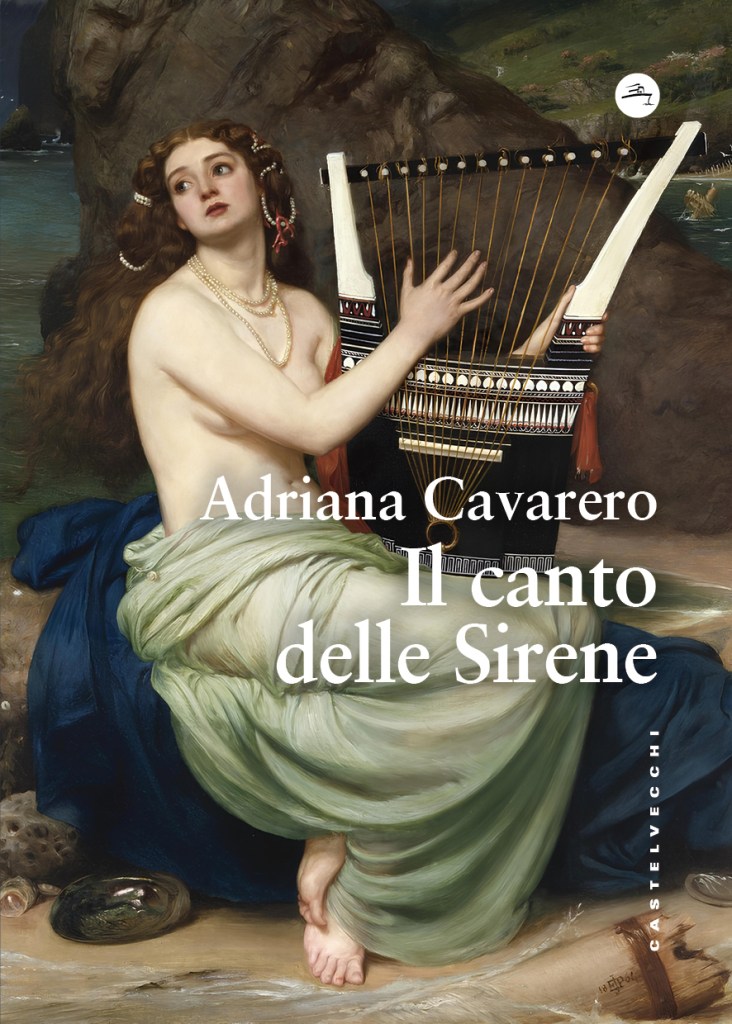
Adriana Cavarero refers to the Sirens in the “Odyssey” as “cantatrici”, a term that does not simply translate as “singers” , but rather conveys the ideas of figures “devoted to the art of singing”.
Much like Homer himself and the Muses, the Sirens serve as omniscient narrators. Their voice is seductive, carnal, primitive and distinctly feminine. For Cavarero, the phonic emission exalted through the song possesses a revelatory function: it communicates knowledge. The Sirens tempt Odysseus precisely through this promise of revelation, claiming they possess complete knowledge of both the Trojan war and all earthly events. Their song thus becomes both an act of narration and a trap, luring men through the seduction of vocal knowledge.
In the original Greek, the voice of the Sirens is described with the term phthongos, rather than phone – used to describe Circe’s voice. Phthongos opens onto a broader semantic field, associated with a vocality in general, encompassing sound, animal cries, and non-human utterances. Homer’s preference for the first term therefore evokes both the animal and the divine dimensions of the Siren’s song, emphasizing the fundamentally inhuman quality of their vocality. Moreover, their voice is described as melichron, literally “flowing from the lips as sweet as honey”.
According to certain mythological traditions, the Sirens were the daughters of a Muse and of the river god Achelous. As hybrid creatures, half women and half animals, they belong to an archaic world endowed with both marvelous and terrifying magical power.
In the Odyssey, Homer frequently introduces figures who function as doubles of the poet himself, thereby emphasizing the power of the song. The Sirens likewise operate as a double of the poet: by claiming omniscience, they present themselves as possessors of total narrative knowledge. Unlike Homer, however, the Sirens are represented as a collective of female voices. They inherited their vocal gift from their matrilinear lineage, the Muses, while their paternal descent Achelous links them symbolically to water. In later iconography, where the Sirens acquire fish-like tails, this aquatic dimension becomes even more significant. The association with water evokes the idea of the amniotic fluid: the sailor, born from the waters of the maternal body, is lured back into the ocean by the Sirens, where he ultimately meets death. The myth thus stages an ancient patriarchal intertwining of Eros and Thanatos, in which the maternal body, symbolized by the sea, function simultaneously as cradle and tomb.
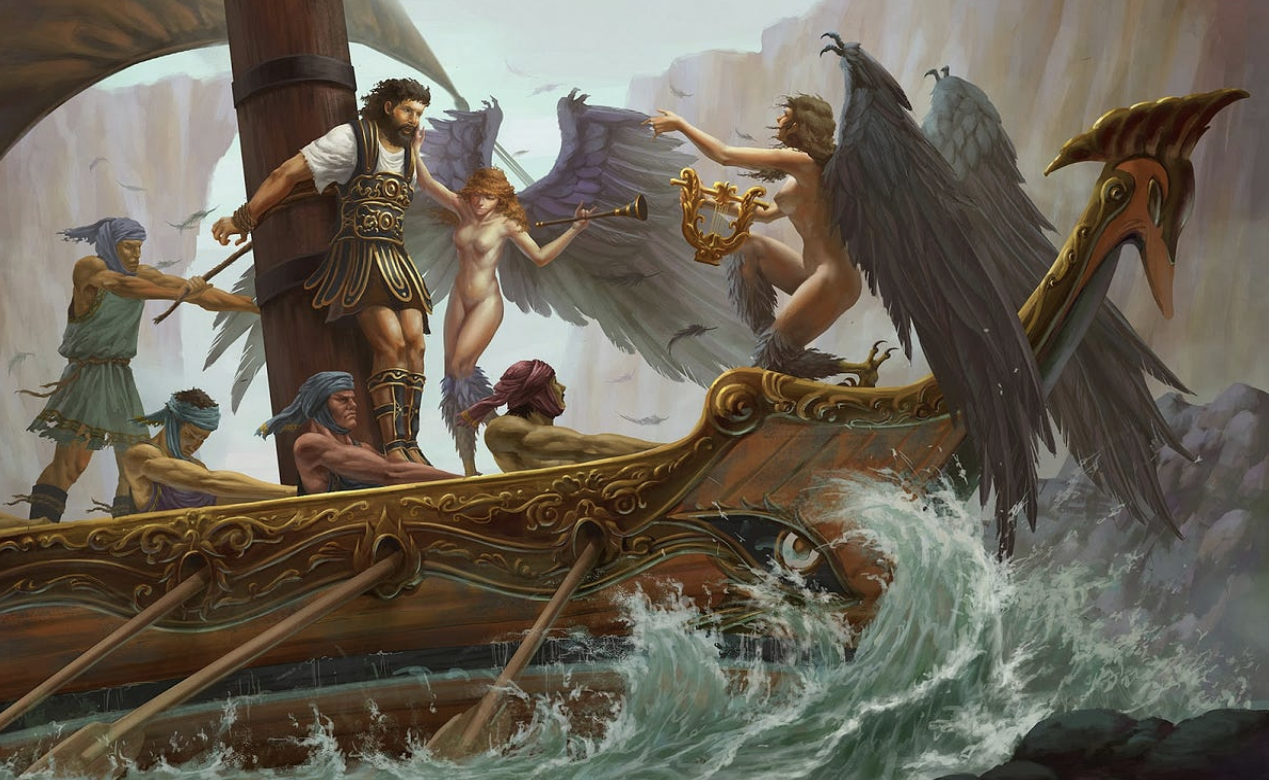
In Homer, however, the Sirens are represented as bird-like creatures, with a rather monstrous original form: they have talons, wings, a round torso and the head of a woman.
This figure undergoes a significant metamorphosis. It is during the middle ages that the iconography of the siren is radically transformed, shifting from the terrifying bird-woman of antiquity to the beautiful mermaid. This transition reflects a broader cultural movement in which female beauty itself becomes coded as monstrous. Medieval Christian thought increasingly associated the Siren with feminine sin and sexual temptation. Unlike the hybrid bird-like creature, the mermaid could conceal her tail and thus appear youthful, innocent and fully human. The Siren consequently came to embody a specifically male fear of female sexuality and seduction.
This metamorphosis is also crucial because it progressively transforms the Sirens into erotic objects. At the same time, their song is reduced to pure vocal seduction, stripped of its semantic and narrative dimension. What disappears is precisely the poetic power that characterized the Homeric Sirens. The voice of the Sirens thus becomes a mere instrument of seduction, while man retains dominion over the logos, rationality, and the discursive dimension of speech. Aristotle defines logos as phone semantike – a “signifying voice”. Within logos, therefore, what ultimately matters is the semantic dimension: meaning takes precedence over sound itself. As Adriana Cavarero observes in “For More than one Voice”, this hierarchy establishes the priority of the signified over the signifier, reducing the voice (phone) to the role of a purely acoustic vehicle for meaning. This separation between logos and phone, signified and signifier, parallels broader gendered opposition in Western philosophical thought. Rational discourse and semantic authority become associated with the masculine subject, whereas the feminine is increasingly linked to pure vocality, corporeality, and sound. Cavarero consequently describes a double process: on the one hand, the masculine subject enacts a “devocalization” of logos, on the other, the feminine undergoes a progressive “desemanticization” of the voice. The Sirens continue to sing, yet their voice is deprived of its original narrative function.
According to Cavarero, one of the most compelling interpretations of the Sirens episode in the Odyssey is that proposed by Theodor W. Adorno. A similar reading had already been suggested by Cicero, who claimed that the Sirens attempt to attract Ulysses through a song containing the knowledge of the history of the world. Adorno takes this interpretation even further, by transforming Odysseus into the paradigmatic hero of the Enlightenment: the subject driven by an insatiable desire for knowledge.
According to Adorno, the song of the Sirens produces intense pleasure in the listener, immersing him in a totalizing perception of happiness that recalls the condition of childhood. This pleasure is profoundly corporeal and so overwhelming that it threatens the dissolution of the self into the melody itself. The sirens on the other hand completely lose their subjective position: reduced to objects existing solely for the pleasure and experience of Odysseus. The Homeric hero’s victory over the Sirens therefore symbolizes the triumph of rationality over mythical and natural forces. Odysseus survives thanks to his wit (and also thanks to the suggestions of Circe).
Later traditions speculated on the fate of the Sirens, after Odysseus successfully escapes their song. Some myths claim that they threw themselves from the cliffs into the seas – an apparently improbable end for creatures endowed with wings. This detail, however, raises a crucial question: what power does the Sirens’ song have if the listener doesn’t die after they sing? Cavarero argues that the Sirens’ song doesn’t disappear entirely. Part of it survives in Odysseus himself, particularly in the moment when he recounts the encounter at the court of the Phaeacians. According to Cavarero, it is not the song itself that kills the sailors, but rather the enchantment exercised by the voice: the irresistible attraction toward the source of the sound, toward those mouths and their honey-sweet vocality.
The Sirens’ song ultimately remains an enigma, a mystery. Odysseus never truly tells the listener what the Sirens were singing. What the myth transmits to us today is therefore the absolute otherness of the Sirens’ song: a sound completely severed from the human world, the expression of a divine, pure, perfect vocality. Franz Kafka goes as far as reducing them to utter silence. In his interpretation of the myth the Sirens do not sing at all. Not a sound. Not a word. Kafka simultaneously dismantles the figure of Odysseus as the Enlightenment hero celebrated by Adorno. Rather than a triumphant subject guided by reason and intellect, Odysseus becomes a ridiculous and almost pathetic figure whose supposed cleverness appears comic and ineffective. The Sirens finally become the true protagonists of the story. By choosing silence instead of song, they wield what Kafka presents as the deadliest weapon: in withdrawing their voice, they also withdraw themselves from Homer’s narrative, preserving the mystery of their song intact. The Sirens no longer desire to seduce or attract men. Rather, Kafka suggests that Odysseus, and perhaps humanity itself, would have been incapable of enduring their silence. The true danger lies not in disappointment, but in the illusion of mastery: in the belief that one has conquered the Sirens through reason, wit and strength, while the mystery in fact remains inaccessible.
A radically different perspective emerges in “The love song of J. Alfred Prufrock” by T.S. Eliot. In Eliot’s poem, the Sirens actually sing to each other, they never sang for Odysseus. Their song is no longer structured around seduction, nor directed towards a male listener. The Sirens do not sing in order to attract men; instead, singing appears as an activity complete in itself. Seduction becomes merely a secondary, collateral effect of a vocal pleasure that exists independently of masculine desire. The focus therefore shifts entirely onto the act of singing itself and onto the joy contained within vocal expression. In Eliot’s reinterpretation, the Sirens’ happiness seems to reside precisely in the reciprocal exchange of the song. The mystery traditionally associated with the Sirens may consequently dissolve: their secret no longer conceals secret knowledge or fatal intentions, but simply expresses the pleasure of vocality itself.
The Sirens have also frequently been depicted as evil, malignant creatures: Apollonius of Rhodes in the “Argonautica” particularly emphasizes their homicidal nature. In this version of the myth, it is Orpheus who first encounters the Sirens and survives. He defeats them by playing the lyre, overpowering their song, rendering their voices inaudible to the Argonauts.
The Sirens have continuously transformed; their myth has been repeatedly rewritten and reinterpreted. Yet across these transformations, one element persists: their voice. They have lost the logos and have come to embody the phone completely.
In the novel “Sirene”, Laura Pugno reduces the voice of the Sirens almost entirely to animal sound. The Sirens’ call becomes a song that human beings are fundamentally incapable of hearing:
“Le sirene non cantavano per l’orecchio umano […] il loro canto vero era un richiamo ultrasonico che faceva impazzire i cani, e forse, per quanto impercettibile all’udito, anche gli uomini”
(The sirens did not sing for human ears […] their true song was an ultrasonic call that drove dogs mad, and perhaps, though imperceptible to the human ear, men as well). In the novel, humans breed, sell, slaughter and consume the sirens as “sea flesh”. Their voice is now reduced to an ultrasonic emission, comparable to the sound produced by animals, as though humanity had become incapable of truly listening to them. Pugno herself stated in an interview that, in her novel, the sirens have “fallen from the heights of myth”, while nevertheless secretly retaining their ancient power.
What the sirens have not lost is their ability to seduce men. Even as objects of consumption, bred, butchered, possessed and eaten, they continue to embody erotic attraction. Yet the predatory dimension traditionally associated with the Sirens disappears almost entirely, precisely because they have been deprived of agency and autonomy and have been reduced to that status of animals. At the same time, the novel suggest that the truly predatory force is not the Sirens themselves, but rather the male gaze that objectifies and consumes them. Unlike Kafka’s reinterpretation, where silence becomes a form of power, the silence in Pugno’s Sirens reflects a radically inverted power relationship between humans and these creatures.
When the protagonist, Samuel, attempts to teach the hybrid Siren to speak, the effort proves futile: the creature can only emit fragmented sounds. At the end of the novel, the hybrid siren hisses the word “Samuel”, yet she does not understand that the sound corresponds to his name. Pugno’s novel is profoundly uncanny precisely because it reflects structures that exist within the real world. The oppression of animals and women appears interconnected through cultural and political mechanisms that reduce both to silence and objectification. The novel therefore raises a final question: are the sirens truly mute, or is it humanity that has become deaf?
Margaret Atwood, in “Siren Song”, restores the logos to the fatal voice of the Sirens. In Homer’s version of the myth, the Sirens attempt to seduce Odysseus through the promise of knowledge, yet the actual content of their song always remains unknown; in later traditions, the Sirens’ song increasingly becomes a pure enigma. Margaret Atwood, instead, overturns this tradition and allows the sirens to reveal such “secret” of the song. Atwood presents a single speaking voice: the Siren claims that nobody knows the meaning of the song because those who hear it either die or fail to remember it.
She then addresses the listener directly: “Shall I tell you the secret, / and if I do, will you get me / out of this bird suit?”. Through this image the author reintroduces the archaic figure of the bird-like Siren and simultaneously transforms it into a form of imprisonment. The “bird-suit” becomes the symbol of a mythical identity imposed upon the Siren herself, a role form which she longs to escape. Unlike Eliot’s Sirens, who find pleasure in reciprocal singing, Atwood’s Siren no longer enjoys singing at all, and she doesn’t enjoy the company of her sisters, which she refers to as the “two feathery maniacs”. The song appears instead as compulsory performance endlessly repeated within the confines of the myth.
The Siren consequently attempts to establish an intimate relationship with the listener. She claims that her song is in fact a cry for help and suggest that only the passing sailor, or perhaps the reader, possesses the uniqueness necessary to save her. Seduction no longer relies on beauty or erotic attraction, rather on her ability to make the listener feel uniquely addressed. The final stanza, however, abruptly dismantles this illusion: “Alas / it is a boring song / but it works every time”. At this moment, both the listener and the reader realize that they have already fallen into the trap. Like the sailors in the myth, they too have metaphorically “leapt overboard”. The Sirens’ confession becomes merely another layer of deception within the performance itself. The supposed revelation of truth turns out to be part of the mechanism of seduction.
Yet Atwood’s poem also raises a more ambiguous possibility. The Siren may indeed desire escape from the role imposed upon her, but she ultimately cannot separate herself from the mythical function assigned to her voice. The “bird-suit” would thus symbolize a predetermined identity historically constructed around the Siren by patriarchal narratives.
Originally an omniscient singer, she was gradually stripped of subjectivity and transformed into an erotic and deadly object of masculine fantasy. At this point, Atwood’s poem strongly resonates with Adriana Cavarero’s reflection on vocality. As Cavarero argues through Italo Calvino’s “A king listens”, the existence of a voice necessarily implies the existence of a living body: a being made of flesh and bone; voice reveals uniqueness. The listener’s failure therefore lies not in an inability to hear sound, but in a refusal to truly listen to the subjectivity carried by the voice itself. Humanity remains trapped in a condition of deafness.
Ultimately, the Siren continues to embody what exceeds rational mastery: the divine, the irrational, the unknowable. Men may attempt to dominate her through reason, possession, just as Odysseus sought to overcome the Sirens through wit. Yet the mystery survives. Like Mia escaping back into the sea at the end of “Sirene”. Human beings may cultivate the illusion of mastery, but beyond the fragile boundaries of civilization, they remain confronted with forces they can neither fully possess nor entirely understand.