

Edited by Angeli Alexia
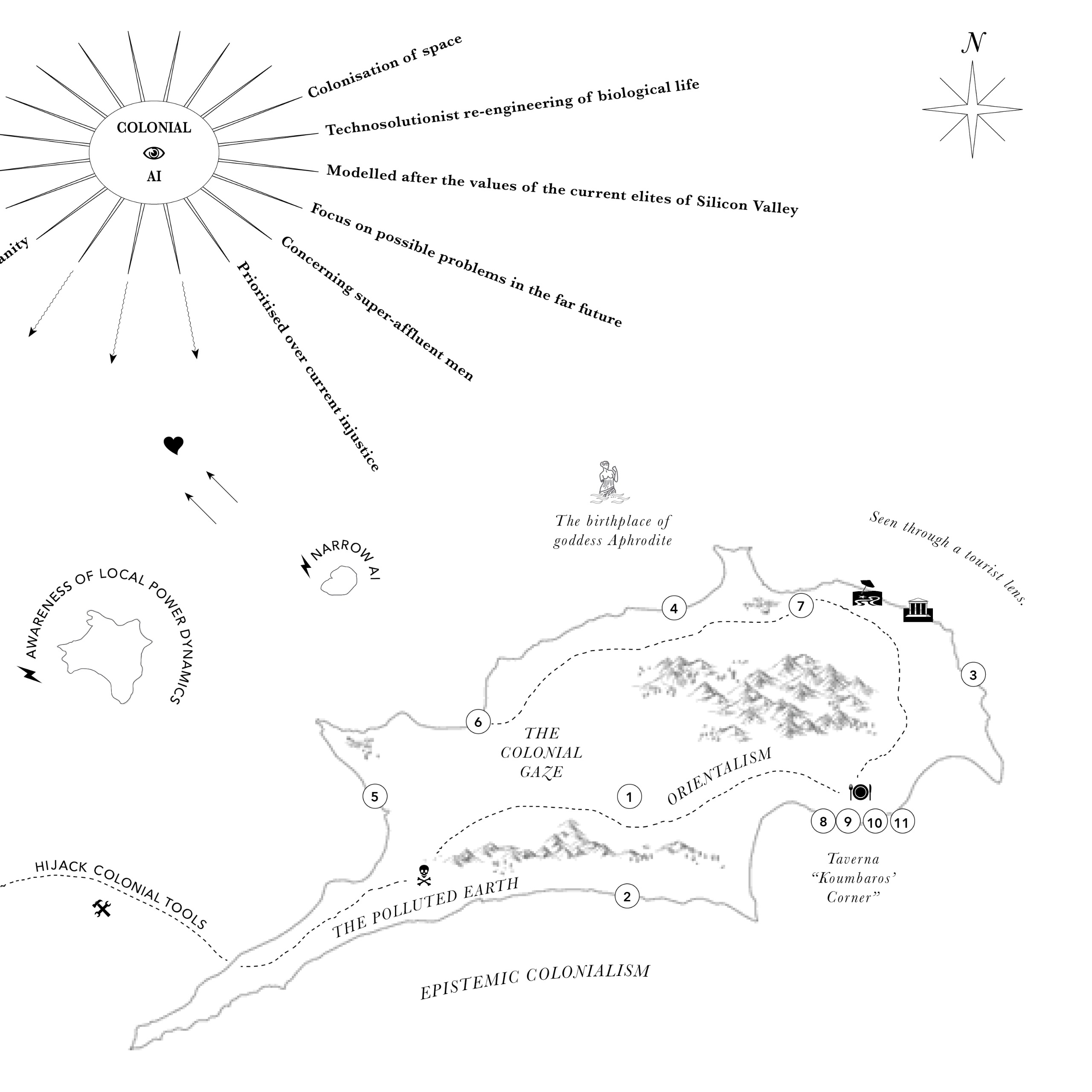
Cover image. Beyond (the sea and) uncanny valleys and American smiles, Alexia Achilleos, 2024, https://alexiaachilleos.com/beyond-the-sea-and-uncanny-valleys-and-american-smiles/
AI in higher education: what’s the issue?
“In this course, the use of AI tools such as ChatGPT, Copilot and Claude is permitted to support critical thinking and analysis”. Disclaimers like this, pertaining to the integration of artificial intelligence in academic curricula, are becoming increasingly common. This phenomenon is attributed to the inherent individuality of students, which renders them difficult to manage effectively. Consequently, lecturers believe it is preferable to grant them autonomy and provide guidance on its utilization, while emphasizing the necessity of citing it as a search engine or “source.” However, the issue is that AI is neither a search engine nor a source. In their quantitative research about the outcomes of AI, Bender et al.1 defined these tools as “Stochastic Parrots”, providing a clear metaphor for their functionality: they merely stitch together linguistic forms based on probabilistic patterns, with no access to meaning or communicative intent. Unlike search engines, which are designed to retrieve documented data, these models are trained on string prediction tasks and often rely on uncurated, biased datasets that overrepresent hegemonic viewpoints. Moreover, they show an absence of commitment to veracity or a structured conceptualization of the world. Consequently, the “coherence” experienced by users is frequently a human-constructed illusion rather than a manifestation of reliable, empirical understanding.
This issue is pertinent in terms of the positionality of the scholars, the integrity of the research, and the specific damage it may cause to individuals. However, the issue raised by the authors in the aforementioned article is of interest here: what is the starting point of these overrepresented hegemonic viewpoints? Through what mechanisms is the hegemony of knowledge reproduced by means of AI?
To answer this question, I will employ Paulo Freire’s work Pedagogy of the Oppressed2. The work explores the relationship between oppression, education, and liberation. Paulo Freire argues that the fundamental problem confronting humanity is the process of humanization, a vocation that is persistently impeded by an inequitable social structure that dehumanizes both the oppressed and the oppressors. Paulo Freire’s oeuvre is firmly embedded within the postcolonial paradigm, despite its frequent categorization as primarily belonging to the domain of “Critical Pedagogy”. The strength of this reflection lies in its utilization of Freire’s theorization as a foundation, employing a postcolonial framework to address broader issues and demonstrate the global reach of these theorizations. Instead, they expose the deeply ingrained logic of oppression and domination inherent in Western behavior, which is sometimes intertwined with neoliberal logic itself.
A new “Depositor”?
Paulo Freire defines the traditional educational system as a “banking” concept and describes it as an instrument of oppression. This notion has its origins in a colonial context and is regarded as a systematic process of dehumanization and cultural invasion. In this context, the educational system serves as a primary tool in perpetuating a “culture of silence” among the dispossessed. In this sense, education becomes an act of “depositing”, wherein the teacher functions as the depositor (subject) and the students are the receptacles (objects) to be filled. This pedagogical approach fosters a passive learning environment, stifling creativity, and encourages students to adapt to external circumstances rather than transform them, thereby serving as a tool of oppression. The instrument of liberation, however, is the dialogical relationship between students and teachers, making both parties “co-investigators”.
The relationship between the oppressed and the oppressor in education systems, specifically in relation to the power relations enforced through knowledge reproduction, can be compared to the situation with AI in higher education. If AI is primarily used to provide rapid responses or to distill information for students to memorize and reproduce, it risks devolving into a high-tech manifestation of the banking model. This turns students into data collectors or cataloguers rather than critical thinkers. That’s why, from a Freirean perspective, the construction of AI systems that are predicated on the values and ideologies of a dominant “metropolitan” society and subsequently imposed upon “dependent” groups (students) constitutes a cultural invasion. Cultural invasion has been demonstrated to be successful when the invaded population becomes “convinced of their intrinsic inferiority” and begins to emulate the behaviors of the “invaders”. Relying on AI to “correct” or “standardize” a student’s voice could result in “self-depreciation,” leading students to perceive themselves as “good for nothing” and “incapable of learning” without the technology.
During this period, it was observed that fellow students were utilizing these tools to summarize complex subjects. Instead of engaging in the restless, impatient and continuous hopeful enquiry that Freire hoped would produce proper critical thinking and liberate our society from hierarchies of knowledge, the students use AI to quickly generate a summary. The student passively acquires this “deposit” of information and regurgitates it in their assignment. Consequently, they become a “collector or cataloguer” of AI-generated data rather than a critical thinker. The question remains as to who is the depositor at this point. It is imperative to ascertain whether the instructor in question is indeed the colonizer.
Can AI be liberating?
As previously mentioned, from a Freirean perspective, the “depositor” is defined as the subject who treats knowledge as a gift to be handed down to those they consider “ignorant”. In the era of AI, this role has become multi-layered, as Cecilia Chan and Tom Colloton explain in Generative AI in higher education – The ChatGPT effect3. The AI assumes the role of the Functional Depositor: in instances where a student requests a summary from ChatGPT and receives a “ready-to-wear” response, the AI functions as the immediate depositor. It provides “lifeless and petrified” content, intended to be “memorized mechanically” by the student. Corporations, as the authors suggest, function as Structural Depositors. The “cultural invasion” occurs when “invaders” (i.e., AI developers and corporations) impose their worldview through the use of biased training data. Because many Large Language Models (LLMs) are trained on “predominantly Global North-centric online data,” they “deposit” a hegemonic viewpoint into the student’s consciousness, potentially marginalizing non-Western linguistic and cultural identities.
Is still the teacher? The educator’s role as the depositor persists, provided that the implementation of AI is predominantly utilized for the purpose of “regulating the the way the world enters into the students.” If an educator uses AI to “automate responses” to students or to provide “petrified” course materials without fostering dialogue, they are still operating under the banking model, merely swapping the human voice for a machine-generated one.
AI can indeed be used as a tool for “problem-posing education”, but only if it is employed to encourage critical thinking rather than conformity. For AI to be liberating, it must function in a specific manner. Firstly, it is imperative to approach AI output as a series of code that requires deciphering. In Freire’s methodology, a “code” is defined as a representation of reality that must be decoded by students. AI can be liberating if its outputs are treated as “existential problems” for students to analyze critically, rather than as absolute truths. The authors further propose a “reverse engineering” model, wherein students are provided with an AI-generated essay to analyze and identify the arguments and rhetorical strategies employed. This shifts students from a passive “object” position to that of a “critical co-investigator” who engages in dialogue with the text. Lastly, cultivating AI literacy as critical consciousness seems necessary, as true liberation requires individuals to “perceive critically the way they exist in the world”. AI literacy — the ability to comprehend, assess and interact with AI while grasping its ethical, social and privacy implications — acts as a modern form of critical consciousness.
- Bender, E. M., Gebru, T., McMillan-Major, A., & Shmitchell, S. (2021, March). On the dangers of stochastic parrots: Can language models be too big?. In Proceedings of the 2021 ACM conference on fairness, accountability, and transparency (pp. 610-623). ↩︎
- Freire, P. (2020). Pedagogy of the oppressed. In Toward a sociology of education (pp. 374-386). Routledge. ↩︎
- Chan, C. K. Y., & Colloton, T. (2024). Generative AI in higher education: The ChatGPT effect. Routledge. ↩︎