
Edited by Corinaldesi Andrea
What does communicating in a nonviolent way mean?
Surely this concept stands to mean that individuals have the possibility to choose how to face confrontation and dialogue both with themselves and with others.
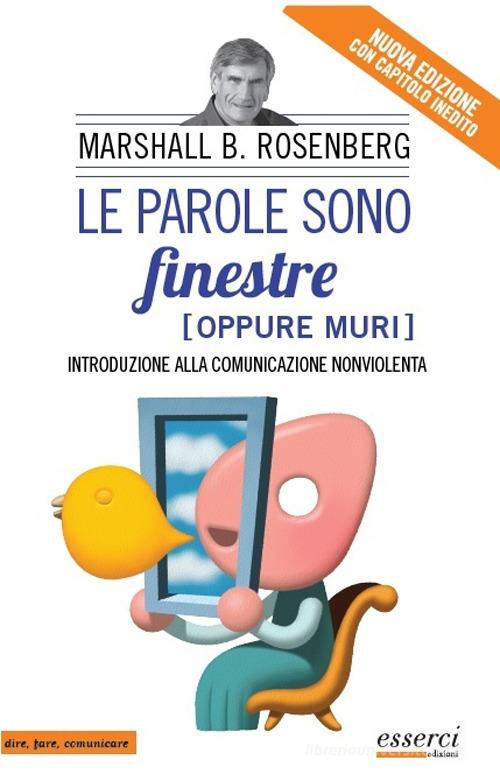
In the book, “Words are windows – or walls”, the United States psychologist Marshall Rosenberg sought to give an answer to the initial question, devising the method of nonviolent communication (NVC).
In a society where conflict seems to be the norm, these pages represent an invitation to reflect on how much the capacity to relate to one another in a respectful way is fundamental.
What the author suggests is that the terms we use daily in individual and collective contexts can have an enormous impact on well-being and on conflicts, starting from the smallest ones. Rosenberg, in particular, speaks of an empathy that can be learned to build a healthy relationship both with oneself and with others. In the text, the psychologist explains how NVC is a powerful tool of mediation for disputes of every type, from personal relationships to the political arena, and how it rests on four fundamental areas.
Firstly, it is important to observe our surroundings without resorting to judgment or evaluation.
A second fundamental point is to pause and reflect on our feelings: this means not having fear of showing one’s own vulnerability, since expressing the deepest feelings can be of help in the resolution of conflicts.
The third component then refers to responsibility, which invites connecting our feelings to what we really need in order to communicate with empathy. This concept, the author underlines, is crucial in a world where expressing one’s own needs can cause fear, particularly for women who have long been taught e to ignore their own needs to satisfy those of others.
How can one therefore be able to communicate with one another having care both of one’s own feelings and of those of others?
The fourth component of NVC invites using a positive action language, without the objective of wanting to change others’ behaviors to our liking, but favoring a climate of relationships based on sincerity and empathy. According to Rosenberg, this will be able to lead naturally to breaking down the walls of communication and to creating a space open and respectful of the needs of everyone.
As the reader turns the pages, the author reports numerous examples of his life in which he has taught the language of nonviolent communication in various contexts. He reports how the learning of this method requires time, listening, and patience.
He also refers to how this tool is a valid alternative to traditional conflict resolution modalities, since it seeks a human connection between the parties. This can seem like a challenging task, as listening to the deep needs of someone who disagrees with us requires commitment rather than judgment.
However, Rosenberg underlines that, if the pain of both is not heard, it is difficult to arrive at a mediation. At the same time, he refers that in situations where communication is impossible, such as in the case of an imminent danger, it could be necessary to resort to the protective use of force, not with the purpose of punishing, but to prevent injustices and injuries.
These are only some of the themes covered in the book, which provide interesting starting points of reflection for today’s world. In fact, today it seems to be difficult to respond with nonviolence. In many social contexts, for example, people often communicate without fully respecting the needs of others. Reflecting on tools that invite a deeper understanding of feelings can therefore be a valid alternative.
Nonviolent communication does not have a clear-cut definition, but it starts with sincere and deep listening: a language that can open glimmers of light and understanding even in those situations where it seems impossible. Reading this text can therefore constitute a valid invitation to pause on themes that are so human, so urgent and often underestimated, where every word has a value.




Leave a Reply