


Edited by Fall Sokhna
Cover image. LONDON, ENGLAND – FEBRUARY 22 2020: Extinction Rebellion protesters holding a CLIMATE JUSTICE banner at the February 2020 march in conjunction with Parents 4 Future. Source: Jessica Girvan on Shutterstock.
Ecofeminism represents an essential intersectional framework that reveals the profound connections between the devaluation of reproductive labour and the degradation of the environment. This approach posits that the exploitation of both human care work and natural resources is a fundamental prerequisite for capitalist accumulation and perpetual economic growth. Within this system, both spheres are systematically devalued, treated as “free gifts” to the economy, and appropriated without charge under the assumption that they are infinitely available. These insights are rooted in Marxist ecofeminist theories, which argue that the destruction of nature and the marginalization of women are not historically accidental occurrences but are structurally linked within the capitalist logic.
The Separation of Productive and Reproductive Labor
The term ecofeminism emerged in the 1970s to describe theoretical perspectives uniting environmentalism and feminism by seeking their common roots. A key explanatory tool for this connection is Nancy Fraser’s theory of social reproduction, which highlights how capitalist society initiated a sharp separation between productive and reproductive labor1. Reproductive labor is the work that maintains both human and non-human life: it encompasses raising children, cooking, cleaning, and caring for the elderly, as well as stewardship of the land. While productive labor is regularized through formal contracts and wages, reproductive labor has historically been confined to the domestic sphere and assigned to women without compensation or legal recognition.
Since the 1970s, feminist scholars have emphasized that this invisible and unpaid domestic work constitutes the indispensable foundation for the survival of the workforce and the production of new generations of workers. Without this unpaid labor, industrial production would be functionally impossible. Although critics may argue that such an analysis is outdated in an era of increased workforce participation for women, empirical data suggests otherwise: even as women have gained access to paid employment, they continue to perform a “second shift,” remaining responsible for the vast majority of unpaid care work2.
Empirical Realities: The “Second Shift” and Global Patterns
To document this reality, researchers utilize international time-use studies to provide a statistical and empirical basis for a phenomenon often dismissed as anecdotal. Specifically, the work of Debbie Budlender (2010) in Time Use Studies and Unpaid Care Work serves as a global reference point, confirming that the “second shift” is a constant across diverse nations. Budlender’s analysis shows that even when women enter the salaried labor market, they remain the primary providers of unpaid care. Furthermore, she documents a lack of substantial cultural redistribution of labor between genders despite decades of feminist activism. Even when care work is shifted into the monetized sector as paid employment, it remains predominantly feminized and systematically underpaid, demonstrating that gender discrimination persists beyond the household.
The structural nature of this inequality is further evidenced by Verónica Amarante and Cecilia Rossel (2018) in their study of Latin America. Their research demonstrates that gendered labor divisions are structural pillars even in economic contexts differing from the Global North. This intersectional approach includes perspectives from the Global South and decolonial critiques, revealing how power asymmetries intersect with regional dynamics. When families can afford it, care work is often commodified and delegated to disadvantaged individuals who work in precarious conditions with low remuneration. In the Global North, the integration of women into the workforce creates “care gaps” that are often filled by migrant workers from rural or impoverished areas of the Global South. This process establishes “global care chains,” which simultaneously create a care deficit in the migrants’ home communities.
The Iceberg Model: Capital as a “Free-Rider”
Reproductive work is frequently viewed as a burden, yet it is a biological and social necessity. Consequently, it is delegated to the most vulnerable subjects, namely those suffering from multiple axes of oppression, including class, gender, and race. This mirrors how capital appropriates the “free” labour of social reproduction and natural resources, treating them as external “gifts”. Maria Mies describes this through the “Iceberg Model” of the global economy, illustrating that the capitalist system depends on a submerged, invisible base.
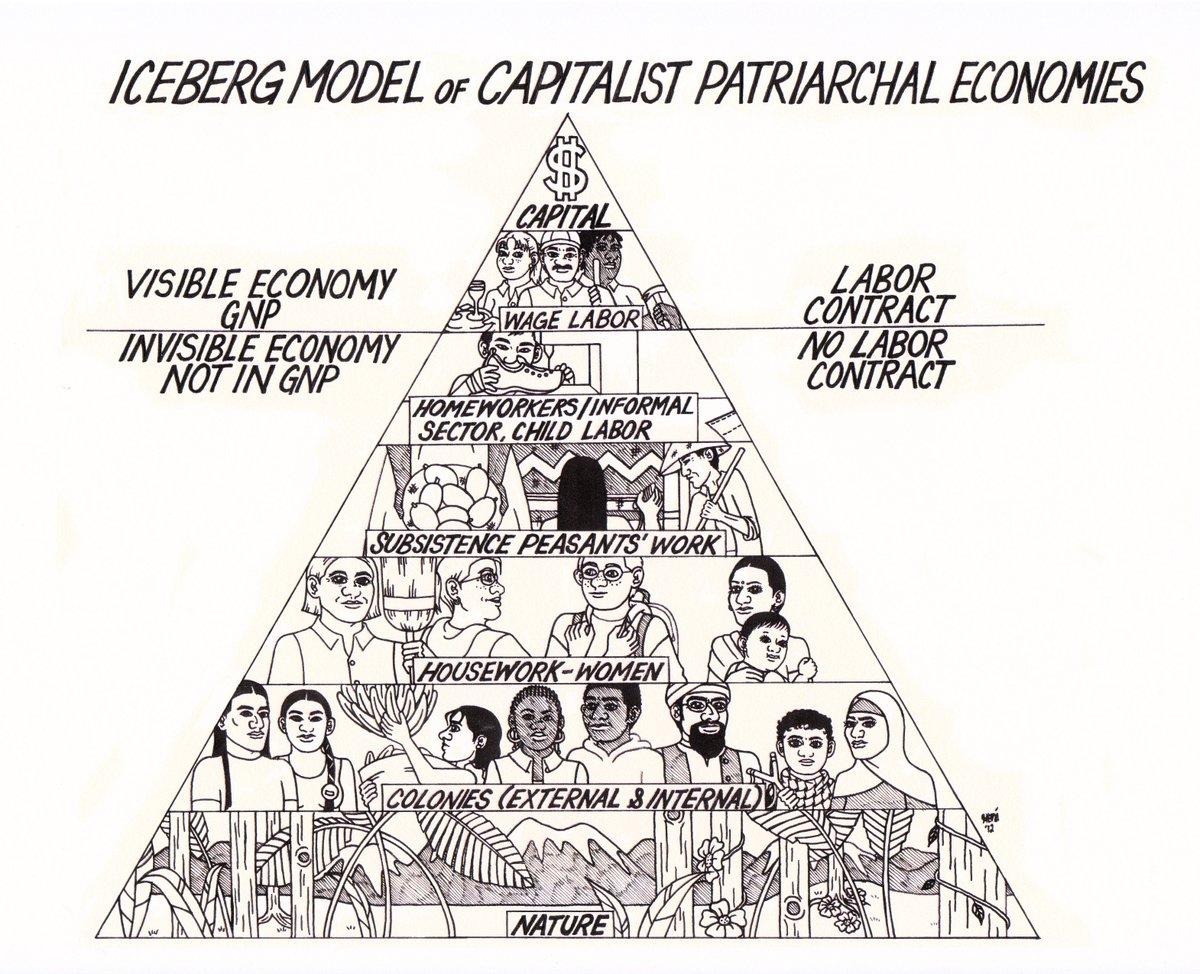
Figure 1. The Iceberg Model of Capitalist Patriarchal Economies. Source: ElfceltRJL on DeviantArt.
The “tip of the iceberg” represents the visible, monetized economy included in GDP, consisting of capital, contracted salaried labor, and the production of priced goods and services. Below the surface lies the much larger submerged section, which includes unpaid care work, the processes of nature and extracted resources, subsistence labor, and the exploitation of “colonies”—both internal and external—particularly in the Global South. Capital operates by treating these bases as infinite resources, practicing a form of “violent expropriation” or “continuous primitive accumulation” to maintain the growth of the visible tip. These submerged bodies and materials provide the energy and cheap inputs necessary for the capital’s survival. This system results in an “ecological debt” and “ecologically unequal exchange,” where the net appropriation of labor and resources from the Global South is calculated at approximately $10 billion annually.
Transformative Strategies: The Capabilities Approach and the Caring Commons
To move toward a society defined by gender justice and environmental sustainability, a radical reorganization of care is necessary. The “Capabilities Approach,” as articulated by Martha Nussbaum and Flavio Comim, suggests that childcare and environmental integrity should be treated as “fundamental political entitlements” and issues of human development3. This framework shifts the focus of social organization away from commodity production and toward the support of human capacities and the sustainability of life.
Several specific strategies emerge from this perspective:
- Commoning Care: Moving the responsibility for care away from the isolated nuclear family toward collective models. This involves creating community support networks that transcend the binary of public and private spheres.
- The Caring Commons: Establishing collectively managed institutions, such as mutual aid systems or community kitchens, where care is practiced as a social commitment rather than a market service.
- Emancipatory De-commodification: Removing care from the logic of profit to prevent it from being managed by corporations that prioritize economic efficiency over the quality of human relationships.
- Redistribution of Time and Labor: A drastic reduction in paid working hours for all genders is required to allow for a genuine sharing of care labor. This would encourage the development of “caring masculinities” and free up time for activities that do not focus on GDP growth.
In conclusion, the current economic model treats care as an invisible “second shift” or a commodified burden. To achieve true sustainability and justice, care must be repositioned as the central driver of social and economic organization. By recognizing care and ecological integrity as fundamental entitlements, society can begin to dismantle the exploitative hierarchies that currently devalue the very labor and nature that make life possible.
- Fraser, N. (2017). Crisis of Care? On the Social-Reproductive Contradictions of Contemporary Capitalism., 21–36. doi:10.2307/j.ctt1vz494j.6 ↩︎
- Dengler, C., & Lang, M. (2022). Commoning Care: Feminist Degrowth Visions for a Socio-Ecological Transformation. Feminist Economics, 28(1), 1–28. https://doi.org/10.1080/13545701.2021.1942511 ↩︎
- Comim, F., & Nussbaum, M. C. (Eds.). (2014). Capabilities, Gender, Equality: Towards Fundamental Entitlements. Cambridge University Press ↩︎