

Edited by Angeli Alexia
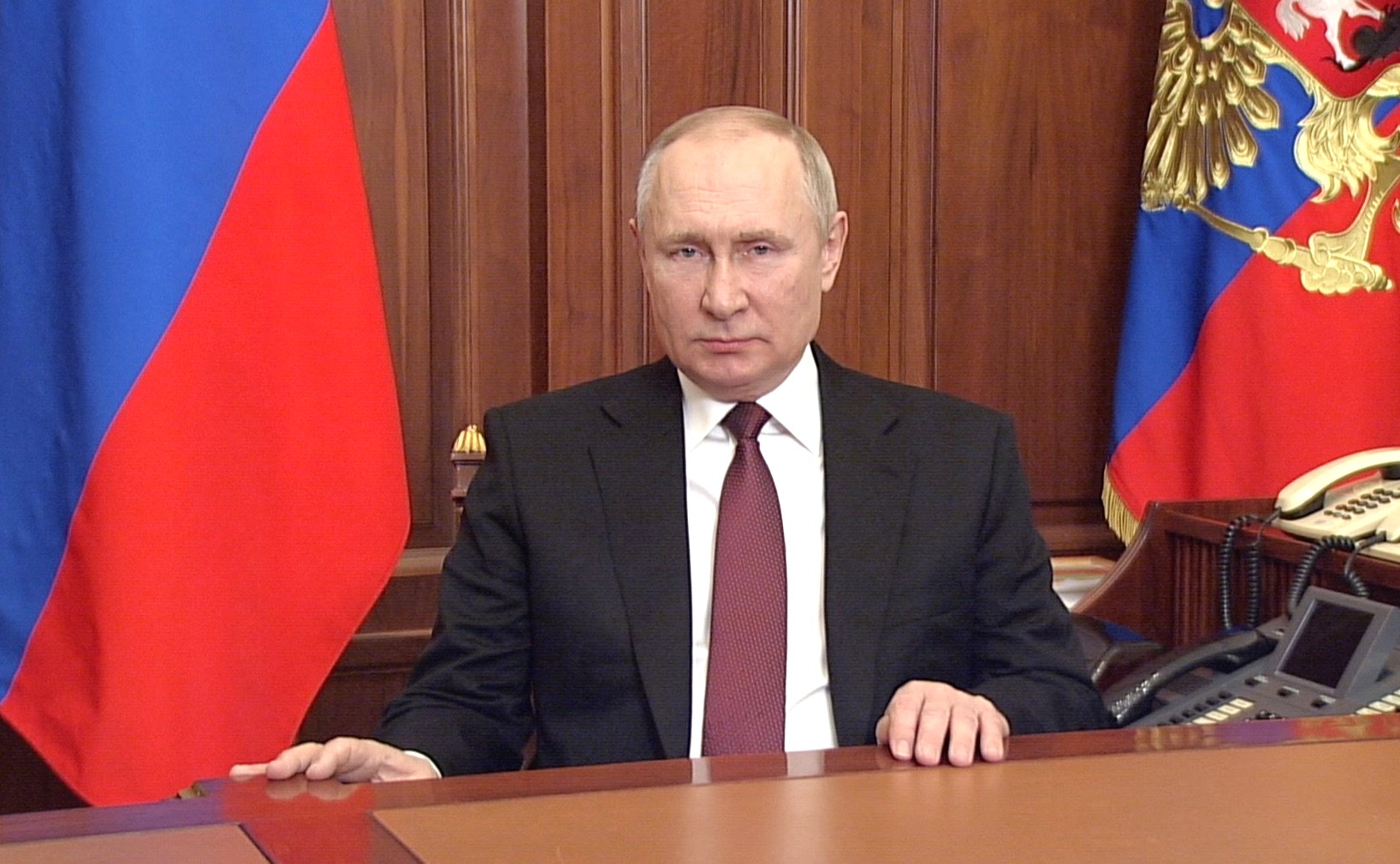
Cover image. Vladimir Putin, Kremlin, 24 February 2022
At the end of February 2022, the global community experienced a moment of collective pause. This development marks the first instance of such a crisis along the borders of the European Union since the Yugoslavian wars. Of course, this is inaccurate; Russia’s incursion into Ukraine began much earlier, but this was the perception – a renovated fear of a third world war. Four years later, this panic has become the new norm. A life in which threat is an everyday occurrence.
I consider it necessary today to speak again about the tragic events in Donbass and the key aspects of ensuring the security of Russia.
This is the opening passage of the declaration. It was necessary to address the “tragic events” in Donbas, as well as to refer to the address dated February 21, 2022, in which he recognized the Ukrainian separatist regions of Donetsk and Luhansk as independent.
I spoke about our biggest concerns and worries, and about the fundamental threats which irresponsible Western politicians created for Russia consistently, rudely and unceremoniously from year to year.
Putin identified a series of “irresponsible Western politicians” and cited the eastward expansion of NATO as a contributing factor. He has also referenced the origins of this “insolent manner” in the dissolution of the Soviet Union.
A reference to Yevgeny Prigozhin is necessary. He was a trusted confidant of Putin, a mercenary and oligarch who led the Wagner group, thus having a pivotal role in the invasion that followed this statement. accusing it of corruption and incompetence in its handling of the war. He further asserted that the government’s justifications for its actions were “lies.” On August 23rd, 2023, two months after launching a rebellion, he was killed along with nine other people in a plane crash.
(…) We saw a state of euphoria created by the feeling of absolute superiority, a kind of modern absolutism, coupled with the low cultural standards and arrogance of those who formulated and pushed through decisions that suited only themselves. The situation took a different turn.
In citing this version of history, he cites many examples, ranging from the military operation in Belgrade to interventions in Iraq, Libya, Syria, and the broader Middle East and North Africa region.
We witnessed lies made at the highest state level and voiced from the high UN rostrum. As a result, we see a tremendous loss in human life, damage, destruction, and a colossal upsurge of terrorism.
At this point, the narrative of the United States as an “empire of lies” starts. It must be acknowledged that the veracity of the narrative in question is difficult to discredit, particularly in light of recent geopolitical developments. This enemy has attempted to dismantle “our traditional values” and exploit “us” for its own benefit for quite a long time, resulting in “degradation and degeneration because they are contrary to human nature.” However, “no one has ever succeeded in doing this, nor will they succeed now.”
Despite all this, “we” tried another attempt to reach an agreement with the West in December 2021, but “the efforts were in vain” because they didn’t change their position, continuing to pursue their own objectives. In recalling the efforts of the Soviet Union to prevent the war in 1940 and 1941, Putin explains how “those who aspire to global dominance have publicly designated Russia as their enemy”.
They did so with impunity. Make no mistake, they had no reason to act this way. It is true that they have considerable financial, scientific, technological, and military capabilities. We are aware of this and have an objective view of the economic threats we have been hearing, just as our ability to counter this brash and never-ending blackmail.
The defense sector is undergoing rapid transformation, but “a military presence in territories bordering on Russia” could potentially generate “an ever mounting and totally unacceptable threat for Russia”. Thus, continuing to attribute the responsibility for this decision to Nato, which “merely serves as a tool of US foreign policy”.
The issue arises when discussing territories adjacent to the borders, “which I have to note is our historical land”. The United States and its allies have implemented a policy of containment, but for Russia, “it is a matter of life and death, a matter of our historical future as a nation”. This brings him to Donbas. “The forces that staged the coup in Ukraine in 2014 have seized power” and are keeping it without following a “peaceful conflict settlement” framework.
For eight years, for eight endless years we have been doing everything possible to settle the situation by peaceful political means. Everything was in vain.
We need to look with “compassion” because “it became impossible to tolerate it”.
We had to stop that atrocity, that genocide of the millions of people who live there and who pinned their hopes on Russia, on all of us. It is their aspirations, the feelings and pain of these people that were the main motivating force behind our decision to recognise the independence of the Donbass people’s republics.
Over 300 scholars on genocide issued a statement rejecting the misuse of the term “to justify its own violence,”1 and Ukraine itself brought a case before the International Court of Justice to challenge this claim, despite the absence of any substantiating evidence.
The West has been accused of providing support to “far-right nationalists and neo-Nazis” in Ukraine, and “will never forgive the people of Crimea and Sevastopol for freely making a choice to reunite with Russia”. Please note the adjective used here.
This claim has also been widely rejected and criticized. The idea is that Ukraine, akin to numerous other nations, is home to far-right groups. However, the extent to which these groups wield influence has been greatly exaggerated. An example is the failure of these groups to secure a parliamentary seat in the latest election.
And the poor, good Russia “already accepted the new geopolitical reality after the dissolution of the USSR”, but they cannot “feel safe, develop, and exist while facing a permanent threat from the territory of today’s Ukraine”.
In the course of employing military forces to confront terrorist groups in the Caucasus from 2000 to 2005, in Crimea and Sevastopol in 2014, and in Syria in 2015, the military found itself in a position where it was compelled to adopt a similar approach.
In these circumstances, we have to take bold and immediate action. The people’s republics of Donbas have asked Russia for help.
In accordance with Article 51 (chapter VII) of the UN Charter, with permission of Russia’s Federation Council, and in execution of the treaties of friendship and mutual assistance with the Donetsk People’s Republic and the Lugansk People’s Republic, ratified by the Federal Assembly on February 22, I made a decision to carry out a special military operation”. In other words, he declared war on Ukraine with the aim of “protect people who, for eight years now, have been facing humiliation and genocide perpetrated by the Kiev regime.
The invocation of Article 51 was openly rejected by lawyers and experts because it allows for the right of self-defense in exceptional circumstances, a category in which the current situation was deemed to fall outside. In the early 2000s, the United States endeavored to implement a similar approach regarding Iraq, an initiative that encountered significant opposition from numerous countries, including Russia.
But let us be reminded “Freedom guides our policy, the freedom to choose independently our future and the future of our children. We believe that all the peoples living in today’s Ukraine, anyone who want to do this, must be able to enjoy this right to make a free choice” because “the current events have nothing to do with a desire to infringe on the interests of Ukraine and the Ukrainian people”, they just have to defend their own country “from the threats created for us and from a worse peril than what is happening now”. This is exactly why “all responsibility for the possible bloodshed will lie fully and wholly with the ruling Ukrainian regime”.
He concludes this announcement trying to convince “those who may be tempted to interfere” not to pursue this way because “Russia will respond immediately, and the consequences will be such as you have never seen in your entire history”. The success and viability of entire states and nations “directly depend on the ability to quickly adapt to constant change, maintain social cohesion and readiness to consolidate and summon all the available forces in order to move forward” of the citizens of Russia. And clearly a sentence had to be directed to the “devoted forces of Russia’s Armed Forces”, who “will perform their duty with professionalism and courage”.
- Journal of Genocide Research, K. Shpend, “beyond Putin’s analogies: the genocide debate on Ukraine and the Balkan analogy worth nothing”, https://www.tandfonline.com/doi/full/10.1080/14623528.2022.2099633 ↩︎