

Edited by Sokhna Fall
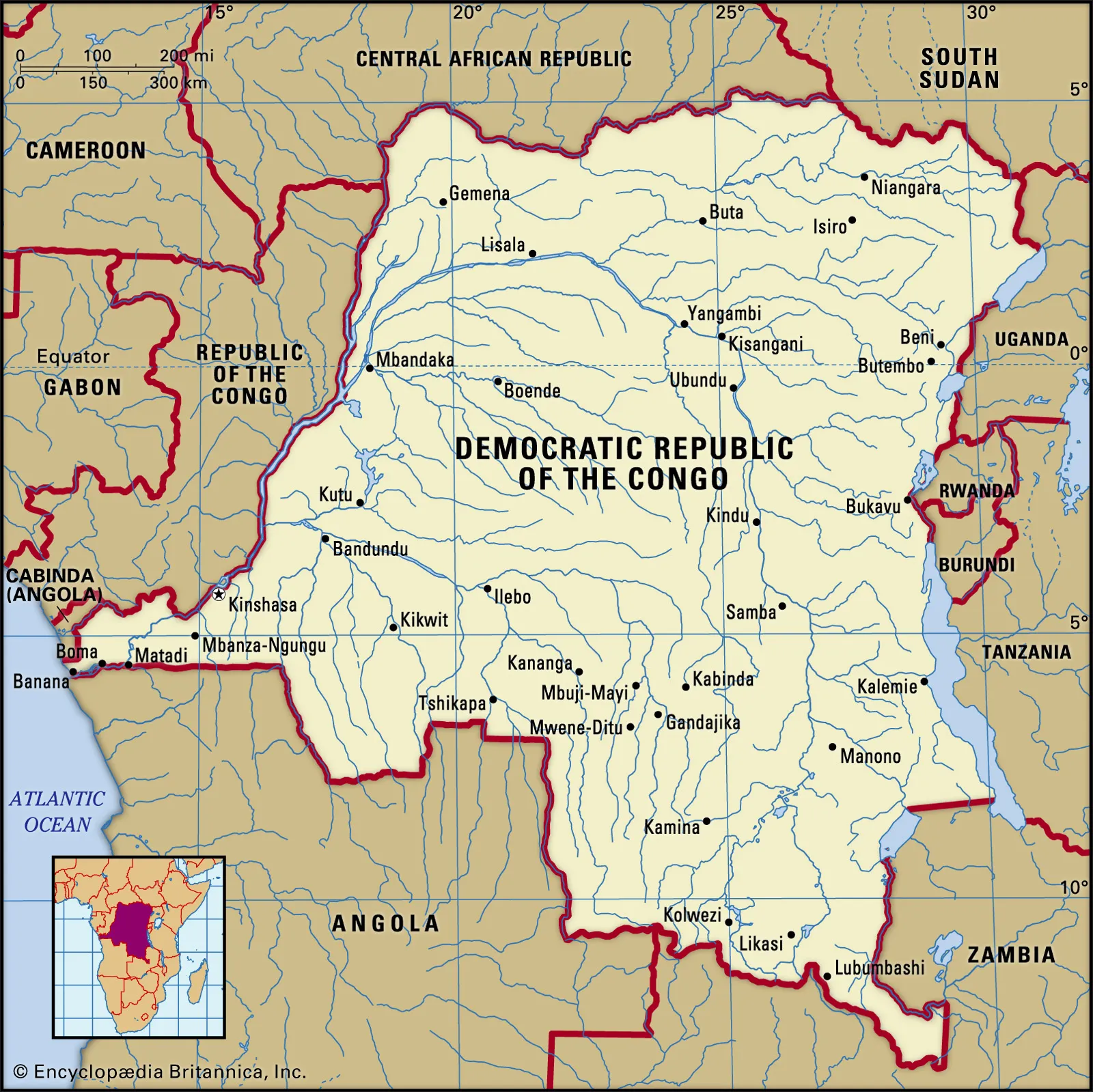
Cover image. Britannica, Democratic Republic of the Congo.
Historical background
The Democratic Republic of Congo (DRC) is a huge and rich insular country positioned at the center of Africa, in the Great Lakes region, five times bigger than France.
After being discovered in the Western world thanks to Portuguese naval captain Diogo Cão in 1482, the major turning point came with King Nzinga Mbemba Affonso, who has been described as a modernizer, astute and innovative leader, eager to learn from European innovations and discoveries. Much of what we know about this period derives from his correspondence, which constitutes the earliest known documents written by a black African in any European language.
Among the many important suggestions to take into consideration, there is the fact that he represented an active player in the slave trade, which he tried to control and use at his own advantage.
Sadly, after his death, the power of one of the most crucial kingdoms of the African continent steadily diminished, and was finally taken over by European colonies by the end of the 1800s.

Image 1. Black Past, Congo Free State
On 29 May 1885, King Leopold II of the Belgians named his new and private country the État Indépendant du Congo.
What followed was a systematic exploitation of the territory and people that remains one of the most horrifying colonial examples of all times.
To collect the required amount of ivory and rubber, the two most important and desired natural resources of the time, the traditional method implemented by the administration was to attack the natives and siege hostages (mainly women) until the tribe brought in the needed quantity. To convince them, some remember cutting faces, ears, hands and noses. In some units there was even a “keeper of the hands” to prove that bullets hadn’t been wasted and actually served to kill. If they turned in dirty rubber, they were forced to eat it.1
The habit of filling baskets with severed parts of the body as proof created a myth in the African society by which the cans of corned beef in white men’s houses didn’t contain meat from animals but rather chopped-up hands.2
This approach was never directly legitimized by the King, but it was instructed in a semiofficial book given by the administration to each agent and each state post.3
Swedish missionary Edvard Vilhelm Sjoblom wrote:
“I saw … dead bodies floating on the lake with the right hand cut off, and the officer told me when I came back why they had been killed. It was for the rubber…. When I crossed the stream I saw some dead bodies hanging down from the branches in the water. As I turned away my face at the horrible sight one of the native corporals who was following us down said, ‘Oh, that is nothing, a few days ago I returned from a fight, and I brought the white man 160 hands, and they were thrown into the river”.4
Additionally, the government foresaw bonuses for state agents according to the number of men they turned over for forced recruitment in the Force Publique and for “reducing the recruitment expenses” by kidnapping them instead of paying the chief of the tribe.5 In 1891, District Commissioner Paul Lemarinel conscripted three thousand porters for a forced march of more than six hundred miles – no one returned.6

Image 2. BBC, Belgium wakes up from its colonial past
Children were not spared too, with Catholic colonies representing the only schooling system planned by the central administration (not by chance, when the DRC obtained independence, there were only 16 graduates out of a population of more than 13 million). These spaces were ruled by the chicotte and the chain, diseases were rife and the death rate often over 50%.7
Many more perished in the journeys to get to the colonies, as this testimony shows: “Of one column of 108 boys on a forced march to the state colony at Boma in 1892-1893, only sixty-two made it to their destination; eight of them died within the following few weeks”.8
The many more brutal habits of the colonizers began to be publicly denounced in January 1890 with the publication of “Open letters” by African-American journalist George Washington Williams, the first comprehensive and systematic written indictment of Leopold’s colonial regime.
The humanitarian activism that followed represents the roots of modern human rights advocacy and merits a dedicated article, but it is worth mentioning the work of Edmund Dene Morel and Roger Casement, who together created the Congo Reform Association in March 1904.
Finally, international pressure forced the King to sell the personal colony to the Belgian state in March 1908 in exchange of assume its 110 million francs debt, pay 45.5 million francs towards the completion of some of his building projects (including the royal residence in Laeken) and another 50 million paid to Leopold himself “as a mark of gratitude for his great sacrifices made for the Congo”. These funds were extracted by the DRC itself.
Through this exploitative system, King Leopold II has been estimated to have gained at least 220 million francs, that would be approximately 1.1$ billion today, without taking into consideration smaller or hard-to-trace sources.
On 15 November 1908 the Congo was renamed Belgian Congo, although the structural governance remained largely unchanged.
King Albert I of the Belgians offered encouraging offers, as he was the first monarch to visit the country and advocate for major reforms; however, the major development was the implementation of a formal taxation system that disrupted the traditional socioeconomic structures and further continued labor coercion.
As in other colonies of the world, anticolonial resistance, based on pan-Africanist ideas, functioned as a necessary condition for modern Congolese nationalism and has been portrayed in Congo by the évolués, evolved petty bourgeois employees and entrepreneurs that could possess at most a secondary education.
After years of clashes and debates, that would be simplicistic to minimize here, on 30 June 1960, King Baudoin of the Belgians officially ceded sovereignty to the DRC.
From that moment on, the country has never been completely at peace and has always undergone a crisis that brought it to the front page of our newspapers.
The Democratic Republic of the Congo
Image 3. Missioni Africane, ricordando Patrice Lumumba
The 1960 pre-independence elections elected radical and progressive Patrice Emery Lumumba, leader of the Mouvement National Congolais (MNC) as Prime Minister and conservationist Joseph Kasa-Vubu, representing ABAKO, as head of state.
Clearly, their interests and ideals soon clashed and mounted the first Congo crisis, begun by a mutiny of the armed forces on 5 July 1960 fueled by the perception that independence would not alter the rigid hierarchy of the military.

Lumumba tried to re-establish the situation through a process of Africanization of the military, rebranded into the Armée Nationale Congolaise (ANC), nonetheless the escalation continued.
On 10 July, Belgium intervened militarily but the Congolaise perceived this response as a further violation of sovereignty and appealed to the United Nations on 12 July.
Secretary-general Dag Hammarskjold authorised the deployment of a UN peacekeeping force known as the Opération des Nations Unies au Congo (ONUC).
The crisis was further compounded by the secession of the mineral-rich Katanga province by Moise Tschombe and Godefroid Munongo on 11 July, which stripped the government of its primary revenue source. The Belgian army intervened by expelling all non-Katangese soldiers and retaining the natives for service in the regional Gendarmerie. The secessionist was eventually terminated only in January 1963.
Additionally, on 8 August 1960, Albert Kalonji declared the secession of the province of South Kasai, supported by Katangese and Belgians.
When the ANC was ordered to crush the rebellion at the end of the month, the resulting human rights violations were strategically leveraged by the UN Secretary-General who labelled the actions as “genocide”. The secession was successfully ended by a military revolt in September 1962.
The head of state Kasa-Vubu utilised the humanitarian allegation as a pretext to dismiss Lumumba from his role as Prime Minister on 5 September and Lumumba attempted to dismiss Kasa-Vubu but both requests were rejected by the Parliament, leading to a political impasse.
On 14 September, Mobutu Sese Seko orchestrated a military coup, resolving the situation by neutralizing both leaders and establishing a college of commissioners to administer the country.
Nonetheless, while Lumumba was placed under house arrest and politically isolated, accused of communism, Kasa-Vubu continued his official functions.
A sophisticated “Barracuda plan” involving Congolese, US, Belgian and UN officials was elaborated to exclude Lumumba from governance and then suspended when he sought protection of Ghanaian UN peacekeepers.
In an attempt to re-establish his power, on 27 November he fled towards Kisangani and was later arrested. Importantly in this case, UN protection was denied.
Patrice Lumumba, Youth and Sports minister Maurice Mpolo and Senate Vice-President Joseph Okito were severely beaten on the plane, overseen by two Luba-Kasai members of the college of commissioners, Ferdinand Kazadi and Jonas Mukamba. On 17 January 1961, they were tortured, personally assaulted by Godefroid Munongo and other Katangese and Belgian officers, and finally executed by a firing squad under the command of Belgian Captain Julien Gat. In a definitive attempt to prevent the burial site from becoming a site of political martyrdom, Belgian police commissioner Gerard Soete and his brother removed the exhumation and subsequently dissolved it in acid.
The role of the CIA was scrutinized by the 1975 Senate Church committee, who found that the US spent almost 12$ million to eliminate the Prime Minister and establish a pro-western Congolese government able to marginalise Soviet influence.
Belgium created a Parliamentary Commission of Inquiry in 2001, confirming its role and recognizing its moral responsibility, that was tried to be compensated with public apologies and a £2.3 million fund for conflict prevention and youth.

Image 4. AfriqueXXI, Etienne Davignon, last witness to Lumumba’s murder and King Baudoin’s gatekeeper
The judicial trajectory intensified on 23 June 2011, when the son of Lumumba filed a criminal complaint against eleven Belgian citizens for their alleged role in the abduction and murder of his father, Mpolo and Okito. On 17 June 2025, the Belgian Federal Prosecutor requested the criminal referral of former junior diplomat Etienne Davignon, the last surviving between the accused. This case represents a landmark legal precedent, being the first time in which the assassination of an African independence leader is being prosecuted as a criminal matter in a European court.
In the last letter to his wife, Patrice Lumumba wrote:
“Neither brutal assault, nor cruel mistreatment, nor torture have ever led me to beg for mercy, for I prefer to die with my head held high, unshakable faith, and the greatest confidence in the destiny of my country rather than live in slavery and contempt for sacred principles. History will one day have its say; it will not be the history taught in the United Nations, Washington, Paris or Brussels, however, but the history taught in the countries that have rid themselves of colonialism and its puppets”.
- Adam Hochschild, “King Leopold’s ghost: a story of greed, terror and heroism in colonial Africa”, New York, Houghton Mifflin Company, 1999, p. 99. ↩︎
- Ibid. ↩︎
- Ibid. ↩︎
- A. Conan Doyle, “The crime of the Congo”, London, Hodder & Stoughton, 1909, p. 33. ↩︎
- Adam Hochschild, op. cit., p. 147. ↩︎
- Adam Hochschild, op. cit., p. 130. ↩︎
- Walter Rodney, “How Europe underdeveloped Africa”, London, Bogle-L’Ouverture publications, 1973, p. 387. ↩︎
- Adam Hochschild, op. cit., p. 130. ↩︎