

Written by

Master’s student in International Relations and European Studies at the University of Florence. She focuses on human rights and social sciences, with a particular interest in field research and interview-based analysis.

Alessia Giustarini
Master’s student in Publishing, Communication Cultures and Fashion at the
Statale University of Milan. Her main interests are journalism, history of fashion, cinema, literature and art.
Edited by Andrea Corinaldesi
Cover image. https://www.bloomberg.com/news/articles/2019-07-02/the-metoo-movement-is-keeping-london-s-top-city-lawyers-busy
In December 2025, the United States government released the long-classified “Epstein Files,” a cache of photographic evidence documenting the abuses attributed to Jeffrey Epstein. The already notorious case exploded in the media, generating bewilderment among the masses.
For over three decades, serious allegations had circled Epstein and, crucially, a wider network of influential figures, from politicians to cultural elites. Yet to frame this case as a grotesque anomaly, risks missing the point. Rather than an unfortunate exception, it should be considered the predictable outcome of precise social structures that enable sexual exploitation to persist.
A striking feature of Epstein’s action was his ability to operate within high-ranking environments and deal with political, economic, and social elites. In such settings, accountability often becomes optional. The 2023 “Atlas of Impunity” ranks the U.S. 118th out of 163, highlighting how impunity is sometimes more of a rule than an exception. Individuals evading accountability becomes a systematic issue as it enlarges discriminatory patterns, not only in terms of economic benefit, but also on accession to justice.
What is the first thing that comes to mind when thinking about Epstein’s case?
Based on what the media reports, one might argue that the most important issue in this case is the names involved in the intricate net of abusers. Secondly, one may think about the victims, about what they had to undergo and whether they received justice.
This answer, beyond being intuitive and straight forward, is also far from being neutral. It reflects the hierarchy of attention through which media tend to organise visibility, privileging those already situated at the top of social and political scale. One may argue that the negative narrative jeopardising the perpetrator’s reputation may prevail over the increasing media attention. In this sense, the issue lies not in a complete lack of attention to victims, but in the conditions under which such attention becomes legible and newsworthy.
A distorted media representation?
Furthermore, media coverage tends to gravitate around recognisable figures, transforming structural patterns of abuse into scandals centred on individual actors. The presence of prominent names offers a narrative anchor, one that is more easily consumed, debated, and amplified. Yet this very mechanism risks displacing the focus from the dynamics that made the abuse possible in the first place.
This asymmetry mirrors the same configurations of power that enabled Epstein’s actions to persist for over thirty years “unnoticed”. Visibility, as with accountability, is unevenly distributed.
If the perpetrators are mostly, as previously noted, rich individuals and high ranked elites, conversely most victims often come from marginalised social backgrounds and disadvantaged family situations. They are lured into the criminal enterprise with the promise of financial compensation.
Those embedded within elite networks are not only more likely to attract media attention, but also to shape the terms through which events are interpreted. Conversely, victims encounter structural barriers that limit both their credibility and their access to institutional protection.
By centering the attention on the involvement of the elite, the risk is to reduce such cases to a scandalistic provocation rather than a matter of justice and morality. This selective visibility does not simply distort public understanding, it can also contribute to the reproduction of impunity as it leaves the underlying mechanisms of exploitation largely unchallenged.
Ultimately, the convergence of institutional inaction, social complicity, and unequal access to justice suggests that the persistence of such abuses cannot be addressed through individual accountability alone. If the Epstein case exposes how systems of power both enable exploitation and shape its representation, the question that follows is not only how such structures operate, but also how, and by whom, they can be effectively challenged and made visible.
Unfortunately, the case of Jeffrey Epstein was not an isolated incident of abuse and violence against women. It is only one example in a much larger and deeply rooted problem that continues to affect our society even today.
The issue is not limited to individuals but is often systemic, rooted in power imbalances and reinforced by social norms or structures that overlook abuse and sexual violence. In addition to that, victims are silenced and perpetrators are protected, which discourages reporting. Two other important cases that we should consider are the #MeToo Movement and controversy surrounding Vice’s editorial staff.
#METOO Movement and the Fight Against Sexual Violence
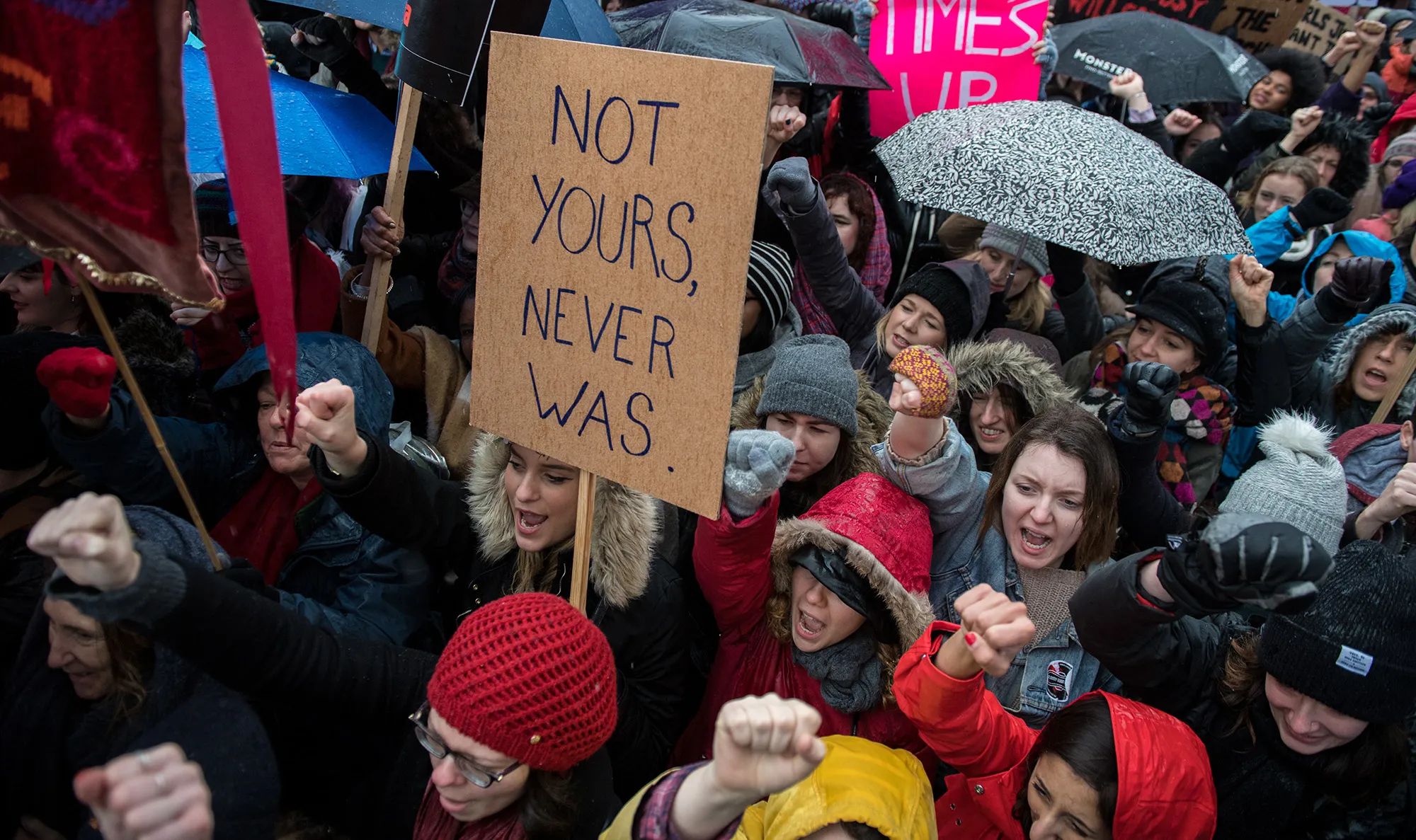
The #MeToo movement is a global initiative aimed at combating sexual abuse and harassment. It also consists of an awareness campaign in which survivors, especially women and public figures, use their voice to share their experiences allowing many survivors to feel heard, believed, and supported for the first time.
The hashtag #MeToo appeared for the first time in 2006 when Tarana Burke, a survivor and activist, used this reporting hashtag on the social media platform My Space to support survivors of sexual violence. In 2017, after multiple allegations of sexual abuse against film producer Harvey Weinstein were exposed, the movement quickly spread across social media as a viral hashtag. The American actress Alyssa Milano posted a message on Twitter, proposing that: “If you’ve been sexually harassed or assaulted write ‘me too’ as a reply to this tweet.”
Soon after, several American celebrities such as Gwyneth Paltrow, Uma Thurman, Angelina Jolie, Jennifer Lawrence and Asia Argento reported Weinstein’s abuse. This led to widespread media coverage and discussions about sexual harassment, particularly in Hollywood. Subsequently, the movement expanded on a global scale, prompting survivors worldwide to come forward and share their experiences of sexual assault. More specifically, women across a wide range of industries began to speak out about instances of harassment within their respective fields.
The #MeToo movement drew global attention to the widespread nature of sexual violence, while also pushing for accountability by challenging workplace power structures that had allowed misconduct to persist. It led to renewed efforts to seek justice for survivors, and in its first year, many high-profile men lost their positions after being publicly accused.
In response to the movement, lawmakers introduced legislation aimed at removing the barriers preventing survivors from reporting abuse, in both the workplace and the legal system. These efforts focused on measures such as mandatory sexual harassment training, limiting the use of non-disclosure agreements, and addressing restrictive statutes of limitations. In 2022, U.S. President Joe Biden signed key federal laws inspired by the movement, including the Speak Out Act, which restricts the use of NDAs to silence victims, and the Ending Forced Arbitration Act, which allows survivors to pursue their claims in court.
Sexual Abuse and Harassment at VICE Media: A Case Study
VICE is a magazine focused on lifestyle, news, arts, culture, and politics. Founded in 1994 in Montreal by Shane Smith, Gavin McInnes and Suroosh Alvi, it started as an alternative punk magazine. The founders later established the youth-oriented media company VICE Media, which encompasses several divisions: a print magazine, a digital platform, a broadcast news unit, a film production company and a record label.
From its beginnings, VICE had a reputation for provocation: the magazine is widely known for its provocative editorial style and its focus on controversial and sensitive subjects. Many journalists viewed this company as their dream opportunity, despite being underpaid: the company was regarded by some as highly desirable, particularly among those aspiring to work in entertainment and journalism. Employees were required to sign a “non-traditional workplace agreement,” acknowledging that they might be exposed to explicit or offensive material in the course of their work. This clause was interpreted by some employees as a restriction on their ability to raise complaints regarding harassment.
The media company had long been rumored to foster a negative work environment for women. This was reflected in a report published by The New York Times on 23 December 2017, which detailed four settlements related to allegations of sexual harassment involving Vice employees. Furthermore, more than twenty women reported “having experienced or witnessed sexual misconduct within the company, including unwanted advances, inappropriate touching, explicit remarks, and propositions for sex.”
As a response, co-founders Shane Smith and Suroosh Alvi said in a statement that the company had taken action over “multiple instances of unacceptable behavior”. In their statement, Smith and Alvi acknowledged that the company’s origins had contributed to fostering a toxic environment in which harassment and sexual abuse occurred frequently. The company then updated its sexual harassment policies, clarified sexual harassment reporting procedures and created an employee hotline.
The present case illustrates how toxic workplace cultures can sustain sexual abuse, revealing institutional failures to protect victims and a tendency to shield those in positions of power. More broadly, such abuse is pervasive across multiple environments, including workplaces, social contexts and institutions, and is reinforced by silence and fear that hinder reporting. Addressing this issue requires a collective effort to support survivors and challenge the structures that enable it, as achieving this requires a thorough understanding of its scale.