

Edited by Corinaldesi Andrea
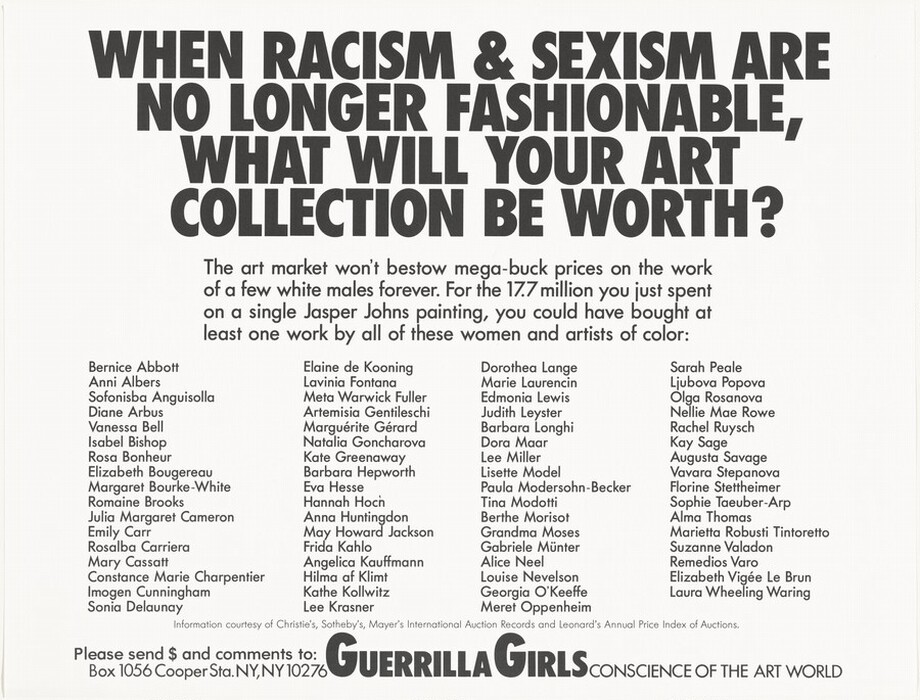
Cover image. Guerrilla Girls, When Racism & Sexism are No Longer Fashionable, What Will Your Art Collection Be Worth?, 1989, offset lithograph in black on wove paper, Gift of the Gallery Girls in support of the Guerrilla Girls, 2007.101.6
Significant progress toward gender equality has occurred over the past 40-50 years, including rises in women’s employment, education, and earnings, but momentum has slowed or stalled in the last decade across key indicators. Recent data confirms that the global gender gap is closing at a sluggish pace, with full parity projected over a century away (England et al., 2020).
Professor Paula England of the Stanford Center on Poverty and Inequality has identified a significant stagnation in the movement towards gender equality, as evidenced by US government data following decades of rapid progress.
While the increase in bachelor’s degree attainment among women is often cited as a major success, England highlights that the integration of fields of study, measured by the “index of dissimilarity”, declined sharply between 1970 and the mid-1980s, and has remained largely unchanged since then. This stalling of academic desegregation is reflected in the labour force, where women’s employment rates rose dramatically through the 1960s, 70s, and 80s, only to plateau at around 70% in 1990, where they have remained for over thirty years. Furthermore, the narrowing of the gender pay gap, which saw a 10-percentage-point gain in the 1980s alone, has slowed considerably in the subsequent decades (England, 2016).
Professor England concludes that these trends are the result of systemic barriers, specifically a workplace culture that operates on the outdated assumption that every worker has a “housewife at home”. She suggests that while women’s roles have expanded to encompass both professional and domestic labour, men’s contributions to the household have not changed at a proportional rate, creating a ceiling for women’s career advancement. However, while these quantitative findings provide a crucial big picture of the stall, they are limited in their ability to uncover the subtle, everyday interactional practices that perpetuate these inequalities.
Recent European data mirror and further explain this American stall. Research by Wouter Zwysen (2024) demonstrates that across the EU, segregation into different industries, occupations, and workplaces accounts for nearly 45% of the total gender pay gap. Crucially, Zwysen (2024) confirms the “devaluation hypothesis” by showing that a job’s social standing and economic reward decrease when women are present. His longitudinal analysis shows that a 10-percentage-point increase in a job’s feminisation is associated with a 9% increase in low-wage workers and a 14.5% increase in involuntary part-time employment. This devaluation affects both men and women in these sectors, suggesting that the “feminisation” of a job depresses overall job quality. While these quantitative metrics from England and Zwysen provide a vital “big picture” of the situation, they remain limited in capturing the underlying cultural mechanisms that sustain these inequalities.
The Theoretical Framework: Nancy Fraser’s Bivalent Justice
To understand why these indicators have stalled, we must utilise Nancy Fraser’s comprehensive framework of social justice, which moves beyond simple economic redistribution to include cultural recognition via the integrated “perspective dualism” model.
Fraser (1998) argues that gender is a “bivalent” category, encompassing both economic-political dimension as well as cultural and evaluative one. Within this framework, gender is initially understood as a distributive matter that organizes the division of labor. This organization divides paid “productive” work from unpaid domestic work, often segregating women into lower-paid service occupations. It also operates within paid work itself, defining specific jobs that are less paid than others just because they mirror the domestic sphere. Simultaneously, “misrecognition” roots gender injustice, as institutionalised patterns of cultural value privilege masculinity and devalue characteristics coded as “feminine” (Fraser, 1998).
The core of Fraser’s conception is “participatory parity,” which requires social arrangements that permit all members of society to interact as true peers. “Status injuries” hinder this parity through publicly verifiable impediments, such as the “ideal worker” norm identified by Professor England, which constitute certain groups as unworthy of full social standing (Fraser, 1998).
However, in these studies, “devaluation” is primarily treated as a causal variable, an explanation, for example, for why wages drop, rather than a broader analytical tool. What is missing is the “analytical turn” found in Fraser’s (1998) work, where the definition of “status injuries” serves as a conceptual framework to explain how these economic penalties are triggered by cultural misrecognition. While England and Zwysen map the distributive symptom, they treat the status-based cause as a sociological observation rather than elevating it to a formal analytical lens that could challenge the “ideal worker” norm.
In this context, Fraser (1998) introduces the “perspectival dualism” as a method of analysing social practices from the vantage points of both redistribution and recognition to explain what these quantitative studies have found.
For instance, if economic policy alone cannot solve the gender pay gap, the cultural perception of “women’s work” continues to categorise low-paying service jobs as unskilled. To address the needle on the stalling indicators identified by England, we must look at the “nonrational, often mindless” processes where these prejudices are practiced daily.
Micro-sociological Research Recommendations
Because quantitative data cannot capture the “latent culture” of institutions or the “deeply knotted threads” of domestic life, I propose four micro-sociological research directions to address the gender equality stall (Beagan, 2001; Doucet, 1996).
1. Analyzing the Platformization of “Dirty Jobs” through the Walkthrough Method (Light et al., 2018)
Future research should utilize the “walkthrough method” to investigate how digital marketplaces reproduce gendered and racialized stigmas. By systematically stepping through the registration and everyday use of apps, researchers can identify “mediator characteristics” (technical icons, interface arrangements, and symbolic representations) that transform the social meaning of work. In the platform economy, gendered jobs (such as cleaning) are often rendered invisible and stigmatized as “dirty work”. Studies in Italy suggest that platforms like Yoopies.it may exacerbate these inequalities by creating new barriers to access for vulnerable migrant women while reproducing offline stereotypes that users expect a “dirty worker” for a “dirty job”. It could be interesting to further examine this dynamic using the framework described to foster the tension between identity and redistribution.
2. Investigating Micro-Inequities in Professional “Latent Cultures” (Beagan, 2001)
Research must explore micro-inequities within high-prestige fields to understand how status injuries persist despite formal equality policies. In medical schools, for instance, women students are frequently mistaken for nurses, addressed as “Miss” while male peers are called “doctor,” and subjected to sexist jokes or gender-biased illustrations in textbooks (Beagan, 2001).
These everyday inequalities are often seen as trivial individually, but their cumulative aggregate burden conveys a powerful message of marginalisation. Understanding these “mindless, habitual” practices is essential to explain why academic and occupational desegregation has stalled. The mutation of Valdez’s (2021) analytical tool of “racial improvisation” could drive this kind of research, and we can define this mutation as “gender improvisation”. Just as “racial improvisation” guided the study of the racialisation of clinical trials towards an analysis of involuntary racial behaviours, the same could be done with gender. This would involve addressing micro-social behaviours as actual drivers of social inequalities.
3. Deconstructing Consumer Injustice and the “Pink Tax” (Lafferty, 2019)
A critical research recommendation is to investigate the “Pink Tax”, the gender price disparity where women are charged more for products and services equal in merit to those for men. This economic discrimination is often justified through gendered marketing and packaging ploys that prey on societal physical expectations of women. Current trade policies and gendered tariff rates also contribute to this disparity, effectively taxing femininity. Research should focus on how these cultural expectations force female consumers to become less price-sensitive, thereby reinforcing the economic cost of being female.
4. Mapping Domestic Responsibility with the “Household Portrait.”
Finally, research should adopt the “Household Portrait” technique to uncover the complexities of domestic labour. Traditional time-budget studies often fail to distinguish between performing a task and taking ultimate responsibility for it. By using visual participatory methods where couples map their division of labour together, researchers can stimulate reflection, debate, and argument that reveals how gendered identities are negotiated. This method is vital because, as Professor England (2016) suggests, women’s professional lives cannot fully “take off” until the cultural devaluation of feminine traits, such as nurturance and interpersonal sensitivity, is redressed within the home.
Moving our focus from general statistics to the micro-level interaction practices can help us to untangle the hidden mechanisms that are currently maintaining the stall in gender equality.
This will enable us to successfully combine redistribution and recognition to address the current stall, thereby creating a comprehensive framework that could integrate the “emancipatory aspects of the two paradigms” (Fraser, 1998).
References
Beagan, B. L. (2001). Micro inequities and everyday inequalities: “Race,” gender, sexuality and class in medical school. The Canadian Journal of Sociology / Cahiers canadiens de sociologie, 26(4), 583–610;
Doucet, A. (1996). Encouraging voices: Towards more creative methods for collecting data on gender and household labour. In Gender relations in public and private (pp. 156–173);
Fraser, N. 1998. Social justice in the age of identity politics: Redistribution, recognition, participation, WZB Discussion Paper, No. FS I 98-108,Wissenschaftszentrum Berlin für Sozialforschung (WZB), Berlin;
Lafferty, M. (2019). The pink tax: The persistence of gender price disparity. Midwest Journal of Undergraduate Research, (11), 56–72;
Light, B., Burgess, J., & Duguay, S. (2018). The walkthrough method: An approach to the study of apps. New Media & Society, 20(3), 881–900;
P. England, A. Levine, & E. Mishel, Progress toward gender equality in the United States has slowed or stalled, Proc. Natl. Acad. Sci. U.S.A. 117 (13) 6990-6997, https://doi.org/10.1073/pnas.1918891117 (2020);
Stanford Center on Poverty and Inequality. (2016). The stall in gender equality: Paula England [Video]. YouTube. https://www.youtube.com/watch?v=eGu8l3fHksc;
Valdez, N. (2022). Weighing the Future: Race, Science, and Pregnancy Trials in the Postgenomic Era (1st ed., Vol. 9). University of California Press. https://doi.org/10.2307/j.ctv2j6xdzv;
Zwysen, Wouter (2024) : What’s a woman’s job? Mapping the contribution of feminisation to gender gaps across Europe, Working Paper, No. 2024.03, European Trade Union Institute (ETUI), Brussels;