

Edited by Corinaldesi Andrea
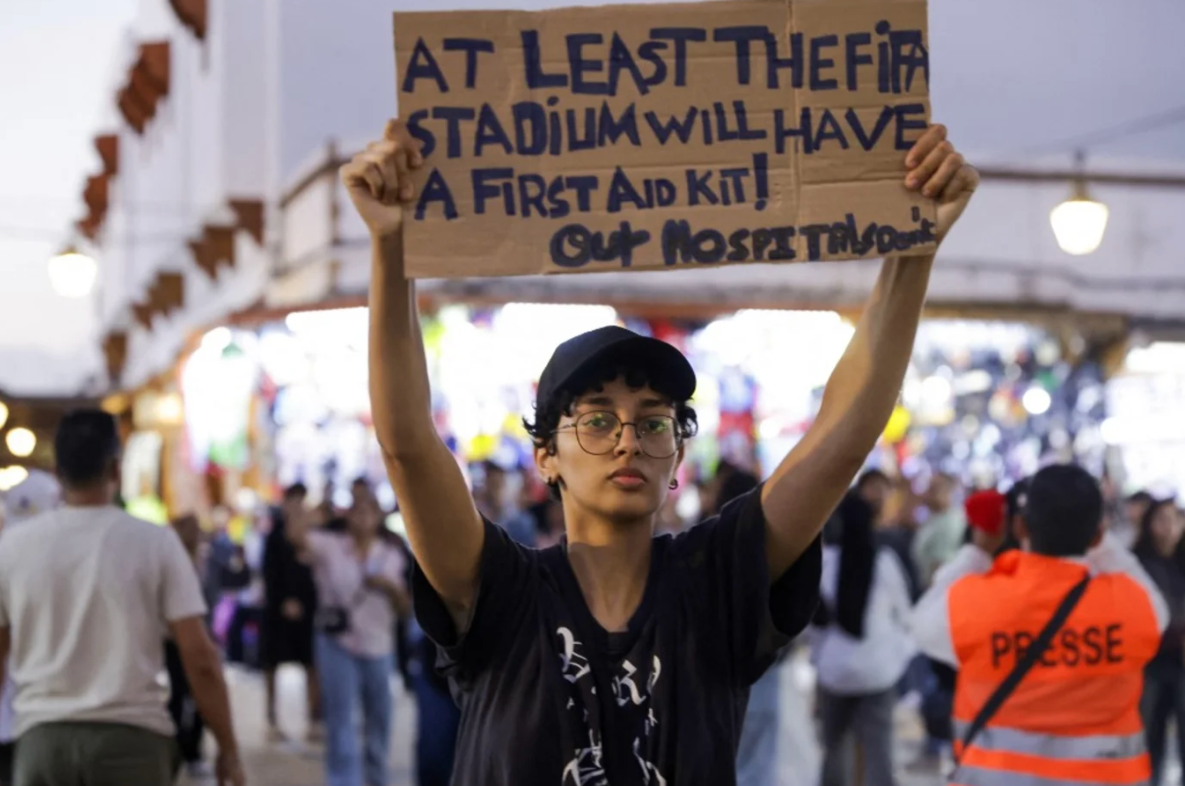
Image 1. A protester at a youth-led demonstration in Rabat calling for reforms in the public health and education sectors, on 29 September 2025 (Abdel Majid Bziouat/AFP)
In early October 2025, the streets of Morocco became the stage for one of the widest protests of the latter years. “Stadiums are here, but where are hospitals”1 echoed in the streets, “At least the FIFA stadium will have a first aid kit!”.
Where does this come from?
To spark the protest the death of eight women2, reportedly killed by wrong c-section procedures performed in the hospital Hassan II, Agadir. The tragic event moved the population to stand up against a collapsing health system. Furthermore, the announcement of the spending for the new infrastructures dedicated to the upcoming FIFA 2030 events, increased the discontent of the Moroccans toward the government. The state announced that around $5 billion3 will be spent on organising the FIFA comprehensive event, with new infrastructures and a stadium4, projected to reach the ground-breaking capacity of 115 thousand spectators. According to some data, in 2024 Morocco’s GDP amounted to $160.61 billion5, making the spending allocated for these events around 2.3% of the total monetary value. Correspondingly, national data report that the same share of money was dedicated to Moroccan health care in 20226.
Following the example set by the innovative Hami Nepal group, which in September 2025 elected Sushila Karki7 as the new leader of Nepal through the Discord online platform, a new youth group has emerged in Morocco. Formed in mid-September 2025 through online platforms, the Gen Z 212 movement8 rapidly gathered over 120,000 members.
Presenting itself as non-partisan and non-confrontational towards the monarchy, the group has focused on issues like health, education, and corruption. Unlike earlier movements such as the February 20 protests during the Arab Spring, Gen Z 212 framed its demands as calls for systemic reform rather than regime change, urging authorities to engage in meaningful dialogue rather than formal adjustments.
What is this all for?
The call for an urgent mobilisation comes directly from Morocco’s demographic reality. A notably young population, with an average age of 30 years9, is facing limited economic prospects due to high unemployment rates (37.6% in September 202510) and ineffective public expenditures on education. School outcomes remain poor despite the increased expenditures in the sector, amounting to 6% of the GDP in 202211, with less than 20 per cent of adolescents achieving minimum literacy and numeracy standards. Meanwhile, public healthcare spending stood far below international benchmarks, leaving nearly half of the population without adequate coverage, especially in rural areas.
How did the government respond?
As the protests continued into October12, tensions escalated. While demonstrations were largely peaceful as claimed by the youth group, clashes with security forces resulted in at least three deaths, hundreds of injuries, and mass arrests. Human rights organisations condemned the authorities’ response, citing repression and excessive use of force.
Although the prime minister broke the silence by expressing a willingness to listen to the protesters’ demands, the events underscored a deeper dilemma: the rising gap between Morocco’s image as a stable, modernising state and the lived experiences of a generation allegedly cut off from a stable future.
On the other side of the ocean: Venezuela.
While the Moroccan protests reflect deep socio-economic frustrations and generational demands for accountability, the political crisis in Venezuela took a dramatic turn in 2026 with the unprecedented U.S. military capture of President Nicolás Maduro.

Image 2. Family members of people imprisoned under the government of Venezuelan President Nicolas Maduro hold placards with their images, as Venezuelans living in Spain gather for a global march in support of Nobel Peace Prize winner Maria Corina Machado, in Madrid, Spain, December 6, 2025 [Ana Beltran/ Reuters]
Just a few days into 2026, the U.S. forces conducted a large-scale operation in Caracas13. Maduro and his wife were captured and swiftly transported to New York to face federal charges, setting the record for an unprecedented action portrayed in the region. The move has raised urgent legal, diplomatic, and human rights questions, underscoring how political violence and contested legitimacy can escalate into full-blown interstate intervention.
Contrasting reactions14 came out from Venezuelans, divided between celebrations for Maduro’s departure and fear for such an invasive military operation. After his alleged fraudulent election in 202415, President Maduro’s government set a climate of political and social control, especially when dealing with the rising turmoil within the population.
How are protests handled by the government?
Notably, several protests across the country were abruptly shut down, with some even ending in tragedy. The Human Rights Watch has received reliable reports that 25 people were killed16 during demonstrations by Venezuelan security forces, while an estimated 2.000 people were detained in connection with such events of active opposition.
“The persistence of these crimes and the absence of adequate justice require a determined response from national and international accountability mechanisms” said Marta Valiñas, chair of the independent international fact-finding mission17, developed under the UN Human Rights Council’s framework.
“The facts we have documented show the role of the GNB in a pattern of systematic and coordinated repression against opponents or those perceived as such, which has continued for more than a decade” Valiñas continued. Reports documented that security forces, including the Bolivarian National Guard (GNB) and pro-government armed groups, systematically engaged in violent crowd control, arbitrary detentions, enforced disappearances, torture, and killings of protesters, opposition figures, and civilians perceived as dissenting, contributing to a climate of fear and impunity.
Interesting was the case of two Venezuelan human rights advocates18, Yendri Omar Velásquez Rodríguez, founder of the Venezuelan Observatory of LGBTQ+ Violence, and Luis Alejandro Peche Arteaga, political consultant. The two were shot and wounded in a targeted attack in Bogotá, Colombia, where they had sought asylum after fleeing persecution. This incident was harshly condemned by both the international public opinion and the national counterparts. Opposition leader María Corina Machado also condemned the incident, underscoring the precariousness of exile and the potential transnational nature of political dissidence in Venezuela.
Once the problems are out, what can be done?
The hardships of an unstable regime and government are structural fragilities that can be addressed through a substantial reform of institutions. However, it is clear that an intervention to remove a problematic leader can just temporarily dab the bleeding wound Venezuelans are suffering every day.
From an external point of view, a change in governance may help a state drift away. Venezuela, as well as Morocco, is experiencing an evolving political crisis rooted in institutional erosion and systematic violations of civil and political rights, not merely isolated episodes of unrest. Demonstrations and public expressions are not to be considered as a revolution, but rather as a symptom of deeper distress.
Around the world: a new wind of manifestations
Alongside the cases of Morocco and Venezuela, Tehran’s streets also saw social and political unrest. At least 35 people were killed19 by the Iranian security forces, and over 1.200 were arrested, as reported by the US-based Human Rights Activists News Agency (HRNA) while protesting against rising inflation.
Minneapolis, US, also saw raging protests following the killing of Renee Good20 by an ICE (Immigration and Customs Enforcement) agent, a few neighbours away from where George Floyd died back in 2020, and the ICU nurse Alex Pretti’s21. These incidents have triggered protests denouncing the use of lethal force, the militarisation of migration control, and the lack of accountability of law enforcement agencies.
While unfolding in a democratic context, the mobilisations echoed broader global patterns of contestation over state violence and legitimacy, linking local grievances to transnational debates on human rights and the limits of coercive power.
- Cfr. Oubachir, A. (2025, September 28). Young Moroccans clash with police while protesting stadium spending and health system decline. AP News. https://apnews.com/article/morocco-protests-youth-corruption-912ca1a9dbc42e6d3d2f8a1067eb12f9 ↩︎
- Roger, S. (2025, October 8). Morocco’s youth spotlight Agadir hospital as emblem of healthcare collapse. Le Monde.fr. https://www.lemonde.fr/en/le-monde-africa/article/2025/10/08/morocco-s-youth-spotlight-agadir-hospital-as-emblem-of-healthcare-collapse_6746215_124.html ↩︎
- Farge, E. (2025, November 13). What is GenZ 212, the group behind the protests in Morocco? Middle East Eye. https://www.middleeasteye.net/news/what-genz-212-group-behind-protests-morocco ↩︎
- Morocco sets the 2030 World Cup stage with the world’s largest stadium. (2025, May 21). SoccerBible. https://www.soccerbible.com/design/miscellaneous/2025/05/morocco-sets-the-2030-world-cup-stage-with-the-world-s-largest-stadium/ ↩︎
- World Bank Open Data. (n.d.). World Bank Open Data. https://data.worldbank.org/indicator/NY.GDP.MKTP.CD?locations=MA ↩︎
- Morocco: Protests Met with Repression, Violence. (2025, October 17). Human Rights Watch. https://www.hrw.org/news/2025/10/15/morocco-protests-met-with-repression-violence ↩︎
- Kharel, S. (2025, September 15). ‘More egalitarian’: How Nepal’s Gen Z used gaming app Discord to pick PM. Al Jazeera. https://www.aljazeera.com/news/2025/9/15/more-egalitarian-how-nepals-gen-z-used-gaming-app-discord-to-pick-pm ↩︎
- Farge, E., op. cit. ↩︎
- Morocco Demographics 2026 (Population, age, sex, Trends). (n.d.). Worldometer. https://www.worldometers.info/demographics/morocco-demographics/ ↩︎
- TRADING ECONOMICS. (n.d.). Tasso di occupazione in Marocco | 1999-2025 Dati | 2026-2028 Previsione. https://it.tradingeconomics.com/morocco/employment-rate ↩︎
- Human Rights Watch, op. cit. ↩︎
- Middle East Eye, op. cit. ↩︎
- Talia, A. (2026, January 4). Delta Force e l’operazione segreta per la cattura di Maduro e Cilia Flores in Venezuela. Il Sole 24 ORE. https://www.ilsole24ore.com/art/znalista-usa-sole-24-ore-ecco-come-sono-stati-catturati-maduro-e-cilia-flores-AIszIAh?refresh_ce=1 ↩︎
- Goodwin, G. E. (2026, January 4). Venezuelans react to US Maduro arrest with hope and uncertainty. https://www.bbc.com/news/articles/c86vq753nwpo ↩︎
- Venezuela election results: Who lost, won and what next? (2025, May 26). Al Jazeera. https://www.aljazeera.com/news/2025/5/26/venezuela-election-results-who-lost-won-and-what-next ↩︎
- Ragozzino, M. R. (2025). Punished for seeking change. In Human Rights Watch. https://www.hrw.org/report/2025/04/30/punished-seeking-change/killings-enforced-disappearances-and-arbitrary-detention?utm_ ↩︎
- Venezuela’s National Guard linked to killings, torture and repression, UN probe finds. (2025, December 11). UN News. https://news.un.org/en/story/2025/12/1166565 ↩︎
- Two Venezuelan exiles wounded in ‘targeted’ shooting in Colombia. (2025, October 15). The Guardian. https://www.theguardian.com/world/2025/oct/14/two-venezuelan-exiles-wounded-apparently-targeted-shooting-colombia?utm_ ↩︎
- Christou, W. (2026, January 7). Iranian security forces clash with protesters at Tehran’s grand bazaar. The Guardian. https://www.theguardian.com/world/2026/jan/06/iranian-security-forces-clash-protesters-tehran-grand-bazaar ↩︎
- Sottile, Z., Ebrahimji, A., & Tsui, K. (2026, January 17). 911 transcripts, incident reports and videos show how an ICE agent shot a mother of 3 at ‘point blank range.’ CNN. https://edition.cnn.com/2026/01/17/us/ice-shooting-minneapolis-renee-good ↩︎
- Meyer, M. (2026, January 26). January 25 2026 – Minneapolis shooting. CNN. https://edition.cnn.com/us/live-news/minneapolis-shooting-ice-protests-01-25-26 ↩︎